Youth field budgeting
How much does it cost to build a youth baseball field?
Real cost ranges, written for the people who actually have to build the budget — ISD facilities directors, parks-and-rec planners, youth-org board members, and the volunteer dad who got volunteered into the field-build committee.
Updated · 2026 North Texas pricing from Bearcat Turf & Outdoors
The short answer.
Costs vary widely with scope, age group, finish level, and site conditions. Here are the three tiers we see most often:
Recreational / T-ball
$40k – $90k
60-ft basepaths, basic backstop, sod outfield, no lights, on a reasonably flat existing site. The "let's just get them on a real field" budget.
Travel-ball grade
$150k – $400k
70-ft basepaths, dugouts, scoreboard, partial turf, real drainage build. The most-installed tier for select organizations and competitive youth programs.
Tournament-grade
$500k – $1.2M+
Full artificial turf, lights, dugouts, scoreboard. No irrigation needed once the field is fully turfed. Bookable for tournaments. The ISD / parks-department / sports-complex spec.
These are realistic North Texas market ranges (Bearcat Turf & Outdoors is DFW-based) and assume a single field, not a multi-field complex. Land acquisition, sitework on a difficult site, and any structural work outside the field footprint (concession, restrooms, parking expansion) are separate.
The number that actually moves
Every price above is a construction cost. Artificial turf is what changes the economics after you build it.
Sod is cheaper to install and more expensive to own: mowing, irrigation, fertilizer, reseeding, and rain-out cancellations all recur every year a grass field is in service. A turf infield or full turf field costs more up front, which is why it shows up in the travel-ball and tournament tiers above, but it plays through rain and adds usable hours no grass field can match. Run your own field size and usage against the math:
Run Your Turf ROI Numbers →How much does a turf baseball field cost?
It depends on how much of the field gets turfed. A turf infield only (the skinned area — mound, plate, basepaths) runs $80,000–$180,000 as a conversion. A full turf field, infield and outfield, runs $200,000–$450,000 for a youth-org build, or $470,000–$1.84M for a competition-grade complex field built for high schools, colleges, or tournament use. The turf and infill material itself is $4–$7 per square foot before base, drainage, and labor.
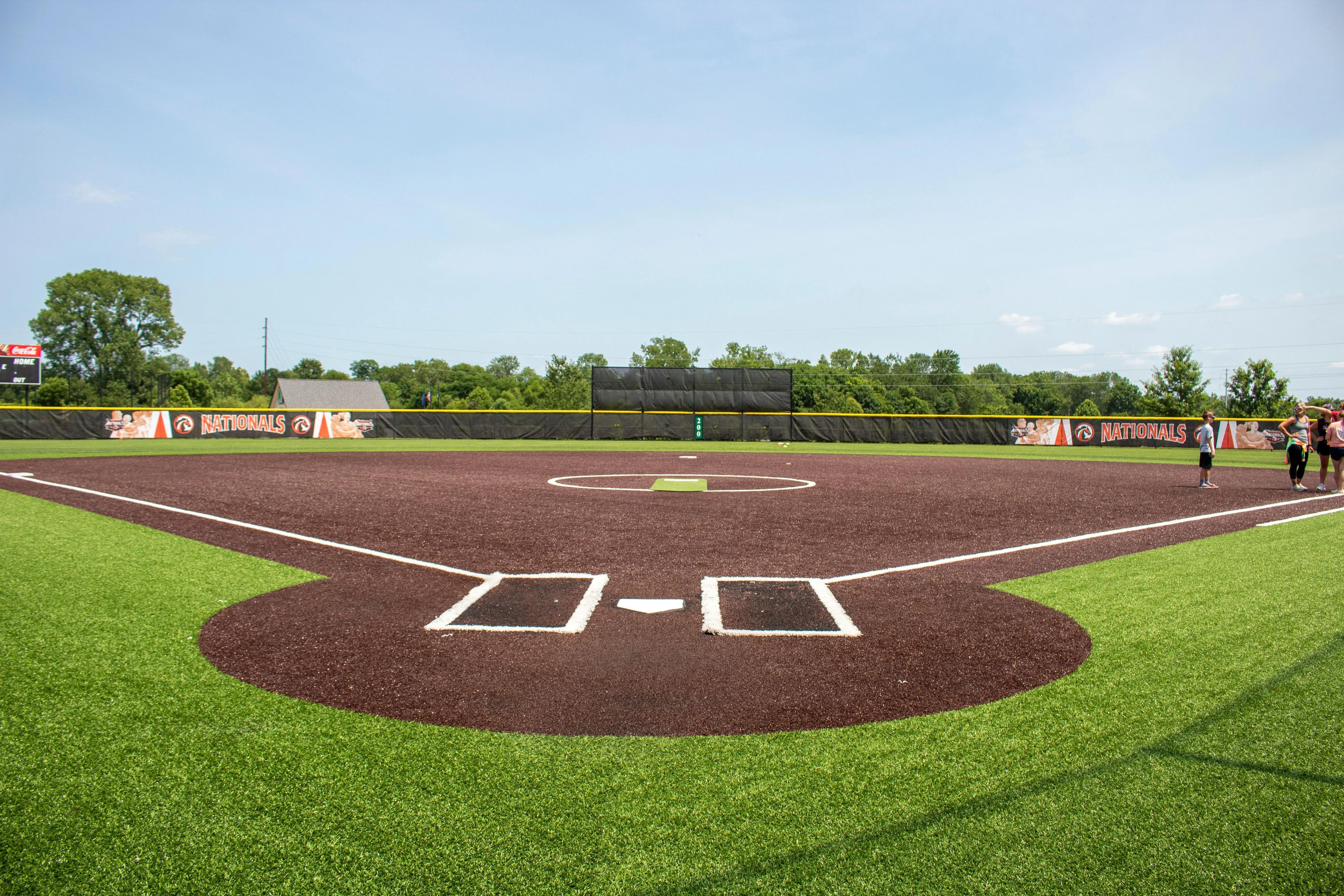
Where the money goes — by tier.
Every youth-field budget breaks down into the same line items. The ranges shift dramatically by tier: full turf can be 35–40% of a tournament-grade build and lights another 20–25%, while a rec field skips both entirely. Each column's line items add up to the tier total.
Rec
$7k – $18k
Travel
$25k – $55k
Tournament
$40k – $80k+
Rec
$6k – $14k
Travel
$20k – $60k
Tournament
$45k – $100k+
Rec
$5k – $10k
Travel
$10k – $22k
Tournament
$15k – $30k
Rec
Sod: $6k – $14k
Travel
Sod or partial turf: $20k – $80k
Tournament
Full artificial turf: $200k – $450k
Rec
$8k – $18k
Travel
$20k – $40k
Tournament
$30k – $65k+
Rec
Benches only
Travel
Pre-fab pair: $25k – $50k
Tournament
Masonry / full: $40k – $100k+
Rec
Not included
Travel
Optional add-on: +$100k – $180k, not in total
Tournament
4-pole LED system: $120k – $250k
Rec
Not included
Travel
Basic scoreboard: $5k – $20k
Tournament
Full scoreboard + PA: $15k – $50k
Rec
Basic system for sod: $6k – $12k
Travel
If sod outfield; skip with turf: $20k – $50k
Tournament
Not needed: full turf = no irrigation
Rec
$2k – $4k
Travel
$5k – $18k
Tournament
$10k – $30k+
Rec total
$40k – $90k
Travel total
$150k – $400k
Tournament total
$500k – $1.2M+
2026 North Texas market ranges. Single-field builds; multi-field complexes are separate. Travel-ball total excludes optional lights. Land acquisition, concessions, restrooms, and parking not included.
Full artificial-turf fields and replacement.
A full competition-grade field, turf infield and outfield, sits above the youth tiers above. It is the spec for high schools, colleges, and tournament complexes. Here is what the wider market looks like, plus what it costs to resurface a turf field once the original surface wears out.
New full-turf field
$470k – $1.84M
DFW market range for a brand-new full artificial-turf field (about $620k–$1.6M nationally). Driven by size, turf quality, infill, lights, and customization.
Replace / resurface
$180k – $650k
About $180k–$300k for a youth-size field, $350k–$650k for a full-size 90-ft field (roughly $5.10–$5.75 per sq ft in recent public bids). The base and drainage stay; only the worn surface is replaced. A once-a-decade line item, not a recurring one.
Turf + infill material
$4 – $7 / sq ft
The surface material itself, before base, drainage, and labor. Full-turf surfaces run an 8 to 12 year life with roughly an 8-year warranty.
New-build and replacement figures reflect recent public bids and industry market data. Your project depends on scope, site, and finish; we quote every field on a site visit. For the general residential/commercial per-square-foot breakdown outside of sports-field scope, see our turf installation cost guide.
Ready to put a number on it?
Tell us about your field and we'll build a real estimate.
Age group, site location, finish level — that's all we need to give you a working budget range within one business day.
10-year ownership math
Natural grass vs. artificial turf: the 10-year math.
Up-front, sod beats turf. Over 10 years of running a real youth program on the field, turf usually wins: far lower upkeep and far more usable hours, because turf needs no recovery time and plays after a storm. Here's the rough math we walk youth orgs through:
| Per year, over a 10-year window | Artificial turf | Natural grass |
|---|---|---|
| Maintenance | $4k – $10k | $20k – $45k |
| Usable hours | ~2,800 hrs | ~800 hrs |
| Cost per hour of useinstall spread over 10 years, plus maintenance | $17 – $44 | $52 – $108 |
Usable hours and cost per hour are full-size field benchmarks from industry market data; a youth field with a sod outfield scales down from there.
Natural grass
~$20k–$45k / year, ongoing
- · Mowing: 2–3 times per week in growing season
- · Irrigation: water bill + system maintenance
- · Fertilizer, herbicide, pesticide
- · Reseeding / overseeding annually
- · Rain-out closures — lost games, lost concession revenue
- · Field marking + striping every game
Artificial turf
~$4k–$10k / year, ongoing
- · Periodic brushing + grooming
- · Infill top-up every 1–3 years
- · Seam and edge inspection
- · Debris cleanup
- · Permanent striping — no per-game marking
- · Playable within hours of even heavy rain
Add the install premium for turf to year 0. Add the recurring delta from grass back. The crossover usually lands in years 4–6 for a youth org with a real practice and game schedule.
Run the numbers for your field
Baseball & Softball Field ROI Calculator
Plug in your investment, projected savings, and rental or tournament revenue. See the crossover year and the 10-year net return — the exact calculation your board or facilities committee needs to approve the project.
Open the ROI Calculator →Decisions that move the budget.
If you have to cut, here's what to cut and what not to cut:
- Don't cut drainage. Skipping the drainage budget is the most common cause of a youth-field teardown at year 5–7. North Texas clay is unforgiving. Get the sub-base right.
- Phase the lights. Build the field "lights-ready" — poles roughed in, conduit laid — and add fixtures in Phase 2 when the budget recovers. The structural cost of going back later is much higher than doing it now.
- Pre-fab dugouts vs. masonry. Pre-fab metal dugouts run a quarter of the cost of masonry. Look the same in photos. Last 20+ years.
- Sod outfield, turf infield. A common compromise that splits the difference. Turf where the wear is concentrated (infield, mound, batter's box) and sod where it's not.
- Phase the turf conversion. Don't have the full conversion budget approved yet? Convert bullpens or the infield first, add the outfield in a later budget cycle. Same base and turf spec each phase, no rework. See our phased field-conversion breakdown.
- Get the dimensions right for the age group you'll actually use. Building a 90-ft field for a 60-ft program wastes money on infrastructure you don't need. Build for the age group you'll spend the most time on, and re-mark seasonally for the others.
- HUB / public bid procurement. If you're an ISD or municipal entity in Texas, work with HUB-Certified vendors (we are) to qualify for HUB participation goals on the procurement side.
Youth baseball field FAQ.
How much does it cost to build a youth baseball field?
Costs vary widely based on scope and finish level. A basic recreational / T-ball field with a 60-ft basepath, simple backstop, and a sod outfield typically lands in the $40,000–$90,000 range. A travel-ball-grade field with dugouts, scoreboard, partial turf, and proper drainage runs $150,000–$400,000. A tournament-grade field with full artificial turf, lights, dugouts, scoreboard, and engineered drainage runs $500,000–$1.2M+ (no irrigation needed once the field is fully turfed). Site conditions, regional labor rates, and finish choices move every number.
How much does it cost to build a baseball field in Fort Worth or the DFW area?
North Texas pricing follows the same national tiers: $40,000–$90,000 for a recreational field, $150,000–$400,000 for a travel-ball-grade build, and $500,000–$1.2M+ for a tournament-grade full-turf field. The regional factor that moves the number is soil: Tarrant, Parker, Denton, Dallas, and Collin county sites frequently sit on expansive clay, which raises the drainage and sub-base line item versus sandier soil elsewhere in the country. We are Aledo-based and quote every DFW field on a site visit so that clay, grading, and access get priced accurately instead of estimated.
How much does a turf baseball field cost?
It depends on how much of the field gets turfed. A turf infield only (the skinned area: mound, plate, basepaths) runs $80,000–$180,000 as a conversion. Full turf on a youth field, infield and outfield, runs $200,000–$450,000 for the turf surface itself, or $250,000–$600,000 once the sub-base and drainage work under it are included. A competition-grade complex field built for high schools, colleges, or tournament use runs $470,000–$1.84M. The turf and infill material alone is $4–$7 per square foot before base, drainage, and labor.
Is artificial turf cheaper than natural grass for a youth field?
Up front, no. Natural grass sod is meaningfully cheaper than artificial turf at install. Over a 10-year ownership window, artificial turf usually wins by a wide margin once mowing, irrigation, fertilizer, weed control, reseeding, and rain-out cancellations are factored in. For youth orgs running a real practice and game schedule, the math typically crosses over in years 4–6.
What are the main cost components of a youth baseball field?
Site prep and grading, drainage, infield surface (clay, mound, plate area), outfield surface (sod or turf), backstop, fencing, dugouts, mound construction, batter's box and plate inlay, lights, scoreboard, irrigation (if natural grass), and parking / spectator access. Each one is a budget lever and each one can absorb a surprising amount of money depending on choices.
How long does it take to build a youth baseball field?
A straightforward T-ball or recreational field with sod can be built in 4–6 weeks once permits clear. A travel-ball-grade field with partial turf, dugouts, and a real drainage build runs 8–16 weeks. A tournament-grade build with full turf, lights, scoreboard, and irrigation can take 16–28 weeks or longer, often paced by the lighting and electrical schedule rather than the field surface itself.
What size is a youth baseball field?
It depends on the age group. T-ball uses 50-ft basepaths and a 35-ft pitching distance. 8U–10U typically uses 60-ft bases and 46-ft pitching. 11U–13U moves to 70-ft bases and 50-ft pitching. 14U and up converts to full 90-ft bases and 60.5-ft pitching, the same as high school and adult amateur. Many youth orgs build a single field that can be re-marked between age groups.
How much does it cost to build a Little League baseball field?
Official Little League dimensions scale by division: 46-ft pitching / 60-ft bases for the Majors (11-12u) division, scaling down for younger divisions and up to 50-ft pitching / 70-ft bases for Intermediate (50/70) and Junior/Senior League. Cost follows the same tiers as any youth field regardless of the exact dimension: a basic Little League-spec field with a simple backstop and sod outfield runs $40,000–$90,000, a travel-ball-grade build with dugouts and partial turf runs $150,000–$400,000, and a tournament-ready complex field with full turf and lights runs $500,000–$1.2M+. The dimensions are standardized by Little League Baseball; the finish level is what actually moves the number.
Do we need lights on a youth baseball field?
Lights are the single most expensive single line item on most youth-field budgets — easily $100,000–$250,000 for a competitive 4-pole LED system. They more than double your usable hours, which transforms the field's revenue and scheduling capacity for a youth org. If your budget is tight, build the field structure ready for lights (poles roughed in, conduit laid) and add the fixtures in a Phase 2.
How much does it cost to convert a natural-grass youth field to artificial turf?
Conversion is typically less expensive than a from-scratch tournament-grade build ($500,000–$1.2M+) because the backstop, fencing, dugouts, and lights are usually already in place. For a standard youth field, expect $250,000–$600,000 for the conversion: full infield and outfield turf ($200,000–$450,000 for the surface), plus the sub-base build, drainage upgrades, and edge, mound, and plate detailing.
Will a turf field still need maintenance?
Yes — but dramatically less than natural grass. Brushing, infill top-up, and seam inspections on a regular cycle, plus debris cleanup. No mowing, no irrigation, no fertilizer, no reseeding, no rain-out drying time. Expect roughly $4,000–$10,000 a year, versus $20,000–$45,000 a year to keep a natural-grass field in playing shape: about a fifth to a quarter of the cost.
What does a full artificial-turf baseball field cost?
A full competition-grade field (turf infield and outfield, the kind built for high schools, colleges, and tournament complexes) sits well above a youth rec field. Industry market data puts a brand-new full-turf baseball field in roughly the $620,000 to $1.6M range nationally, and about $470,000 to $1.84M in the DFW market, driven by field size, turf quality, infill choice, lights, and customization. The turf and infill material itself runs about $4 to $7 per square foot.
How much does it cost to replace an artificial turf baseball field?
Replacing the worn surface on a field that already has its base and drainage costs far less than a new build, because you are not redoing the earthwork or drainage layer, only the playing surface. Recent public bids put replacement at about $5.10–$5.75 per square foot. For a youth-size field (roughly 35,000–50,000 sq ft of turf) that is about $180,000–$300,000; for a full-size 90-ft competition field, roughly $350,000–$650,000. Turf surfaces typically last 8 to 12 years and carry around an 8-year warranty, so resurfacing is a once-a-decade line item, not a recurring one.
About Bearcat Turf & Outdoors.
We're a family-owned, Aledo-based artificial turf and sports-field installer serving the DFW metroplex. We've installed competitive baseball, softball, and multi-sport fields for ISDs, schools, youth organizations, and private families across Tarrant, Parker, Denton, Dallas, and Collin counties — including the multi-sport build at Coder Elementary in Aledo. We're HUB Certified for public-sector and qualifying procurement.
Our scope on a youth-field build typically covers the surface (turf or sod coordination), engineered sub-base and drainage, infield clay coordination, mound and plate detailing, edge/transition work to fencing and dugouts, and ASTM-aligned safety testing on tournament-grade turf installs. We coordinate with the lighting, scoreboard, and structural trades on the GC's pull-plan.
Have a youth field on the board?
Tell us about the project — age group, site, finish level — and we'll walk it with you, recommend a tier, and put together a real number. Free site visit, no obligation. We respond within one business day.
1
You describe the project
Age group, site location, finish level, and any constraints. Takes five minutes by phone or form.
2
We walk the site
Free site visit. We confirm drainage, dimensions, existing infrastructure, and any scope we'd scope differently than a generic bid.
3
You get a real number
Not a range. A line-item estimate you can take to your board, your ISD facilities director, or your parks-and-rec committee.