For Architects, Engineers, & Public-Bid Procurement
How we build a premium field.
Bearcat's field-build standard: ASTM drainage guidance, G-Max safety ranges, regulation mound and plate geometry, and bid-ready documentation. The same engineering discipline whether it's a school field, a tournament complex, or a multi-sport estate build.
What's under the surface
A Bearcat sport-field section, layer by layer.
Sport fields fail when somebody cuts the base. Here's the exact spec we build to — engineered for ASTM compliance, GMAX impact attenuation, and a 15-year service life.
Tap a layer to read the engineering detail.
Layer 1: Sport-grade turf
Slit-film or monofilament fiber engineered for repeated cleated impact. Seam tested to ASTM F1936 specifications.
Spec: ASTM F1936 (synthetic turf for athletic fields).
Layer 2: Performance infill
Engineered blend of silica sand + crumb rubber (or alternative TPE / cork blends). Application rate validated to GMAX impact attenuation specification for the field type.
Spec: GMAX < 165 (per ASTM F355) at install and after 8 years.
Layer 3: Shock pad (optional)
Closed-cell foam underlay. Required for IPEMA-certified playground installs and recommended for high-impact athletic fields.
Spec: IPEMA / ASTM F1292 critical fall height rating.
Layer 4: Compacted aggregate base
Larger aggregate (1" → 3/8" graded). Two-lift install, compacted to 95% Standard Proctor. Sport-field bases are deeper than residential to handle dynamic loads from cleated traffic.
Spec: 95% Std Proctor across both lifts.
Layer 5: Drainage system
Perforated PVC drain network on a 1–2% laser-graded slope. Geotextile separator above. Where soil conditions require, a sub-base lime or cement-treated stabilization layer.
Spec: Drainage rate > 30 in/hr per ASTM F1551.
Drainage — ASTM F1951 / F2765
Our baseball and softball infield installs are engineered to ASTM F1951 (Standard Test Method for Accessibility of Surface Systems) and ASTM F2765 (Standard Specification for Synthetic Turf Systems) drainage benchmarks. Typical vertical drainage rates exceed 30 inches per hour on a properly prepared subsurface — orders of magnitude faster than compacted natural infield mix, which turns to mud at 0.5-2 inches per hour.
- Subsurface base: 4-6 inches of graded, compacted crushed stone (Type 1 dense-graded aggregate, compacted in 2-inch lifts to 95% standard Proctor).
- Drainage slope: 1-2% grade to perimeter french drains or existing storm infrastructure. Slope plan submitted with bid documents.
- Commercial weed barrier: 15-year-rated barrier installed on top of the compacted sub-base, below the turf, to prevent weed and root intrusion for the life of the install.
- Playable in 30 minutes after typical North Texas rainfall events, vs. 24-48 hours for natural infield after the same event.
Safety — G-Max & ASTM F355
Our sports field turf systems are spec'd to G-Max values compliant with ASTM F355 and F1936 guidance for player safety. Target G-Max at install is typically 100-120, well under the 200 safety threshold set for general athletic fields. Shock-absorbing pad options available for competition-level installs requiring lower G-Max values.
Regulation geometry
All Bearcat field installs are built to the governing body's current regulation spec for the division the field will host. We bid and build to:
- USA Baseball / Little League: 60-foot and 90-foot base paths, regulation mound height and slope, home plate detail.
- USSSA / Perfect Game / select: tournament-spec dimensions, custom foul-line and batter's-box detail, inlaid team and sponsor logos on request.
- NFHS (high school) baseball: 90-foot base paths, mound and plate to NFHS current rulebook.
- USSSA / ASA softball (fastpitch & slowpitch): 60-foot base paths, regulation pitching circle, skinned-area detail to match league spec.
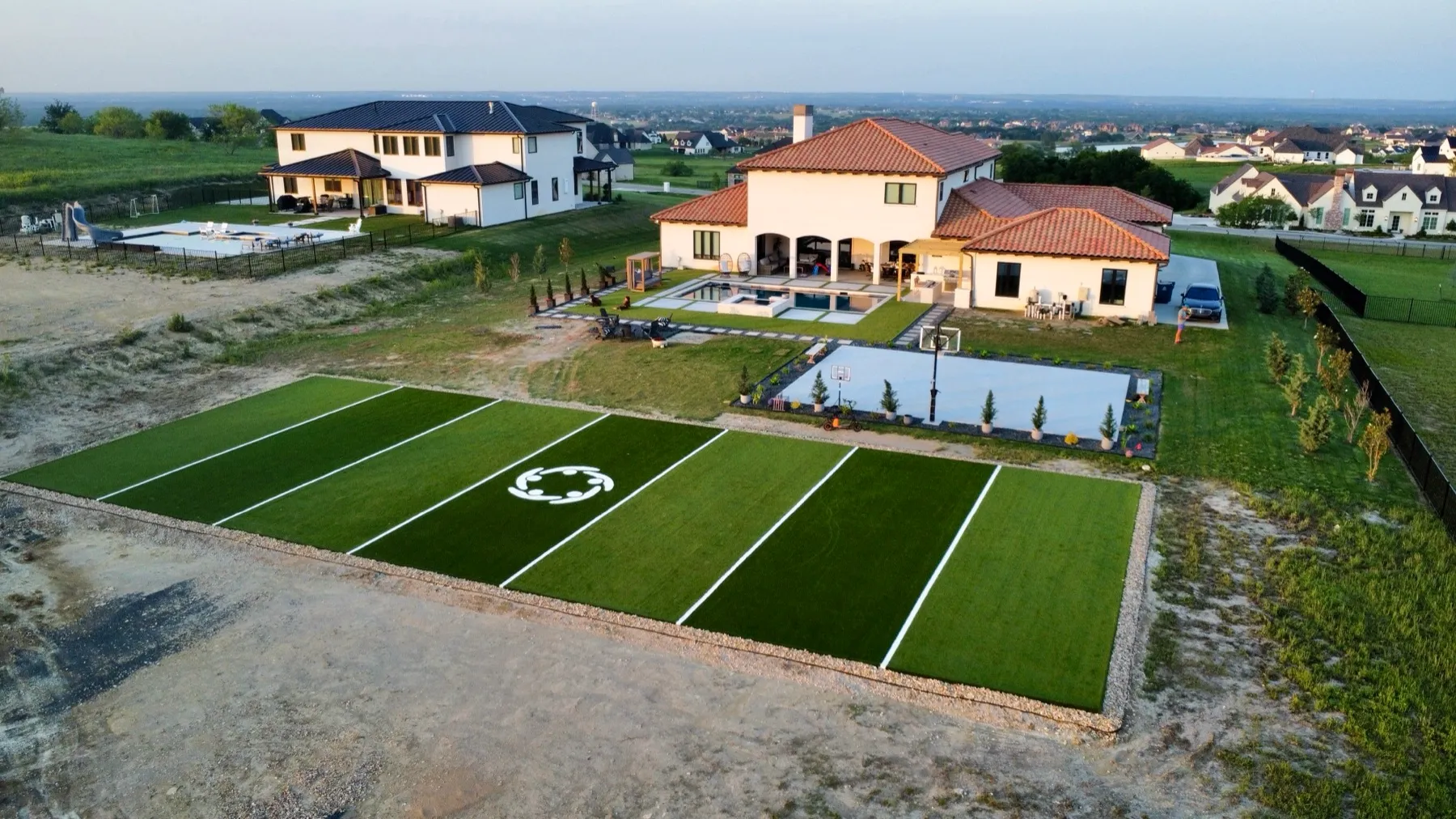
How we generally build full-scale fields.
Every field we build follows the same engineering discipline whether it's a 200,000-square-foot multi-sport surface or a smaller school baseball install. The specifics scale to the project — pipe length, curb run, pad density, turf system — but the sequence and the standards do not. Here is how a Bearcat field comes together when we walk onto a real site.
Site work and contract
- We provide materials, labor, equipment, and supervision.
- Insurance, payment bonds, and performance bonds provided as required.
- Subgrade is delivered to spec by the site contractor — stabilized, balanced, and compacted to the geotechnical report's tolerance — before we start.
Perimeter and turf attachment
- Continuously reinforced concrete curb at the full field perimeter, sized to the project. The curb is the structural shoulder that keeps the turf system from migrating over the life of the field.
- Composite turf-attachment nailer installed along the interior face of the curb so the turf seams to a solid edge instead of a stone face.
Drainage system
- Impermeable liner installed over the entire sub-grade. Water moves laterally on top of the liner toward the collector system rather than soaking into the clay below.
- Perforated HDPE collector network installed in trenches lined with impermeable liner and backfilled with washed drain stone. Trunk and branch line sizes scale to field square footage and storm-event design rate.
- Solid HDPE stub-out for connection to the site stormwater system, sized to discharge the calculated peak flow without backing up into the field.
Base and laser grading
- Drain stone base layer over the lined sub-grade, depth scaled to the field design, then fine-graded with laser-guided equipment to the finished elevations called out in the turf system design.
Performance system and turf
- Performance pad on top of the stone base. The pad spec is selected to the use case — G-Max impact attenuation for play safety, energy-restitution for ball response, and lifespan to match the turf above.
- Synthetic turf system selected for the sport mix on the field, with multi-sport field markings inlaid for each age group or league using the surface (different colors per division so coaches and refs read the lines instantly).
- Performance infill brushed in to manufacturer specification, blended for the sport, climate, and use intensity.
Warranty, equipment, and handoff
- Manufacturer warranty on the turf system, documentation submitted with the bid and delivered to the owner at completion.
- Tow-behind maintenance equipment provided to the owner at handoff, sized to the field. Field staff is trained on its use before we leave site.
- Owner's staff training in the ongoing care and maintenance of the field.
- Maintenance manual delivered to the owner for reference, with the recommended service cadence and consumable list.
The sequence is the same on every field we build; the dimensions, materials, and product choices scale to the project. We pick pad density, turf system, and infill blend to the sport mix, climate, and use intensity — not to a single product line.
Warranty & post-install support
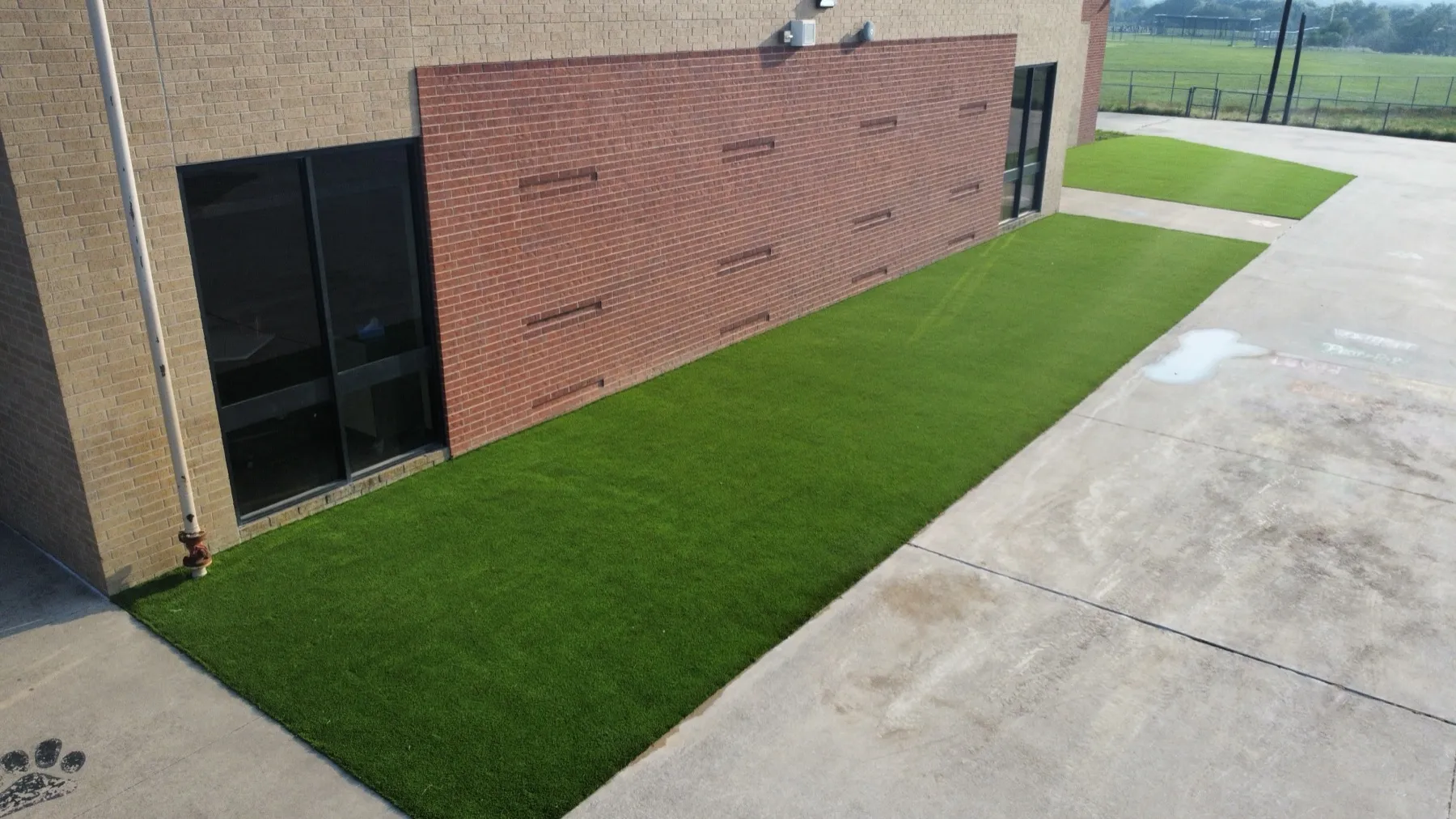
- 15-year manufacturer product warranty on turf fibers and backing, prorated per manufacturer terms. Warranty documentation provided with bid submission.
- 1-year installation warranty on seams, edges, infill top-off, and drainage performance. Covered in full, not prorated.
- Maintenance schedule provided to agency facilities staff at handoff: quarterly brush-and-inspection, annual infill top-off budget, 10-year mid-life evaluation.
Bid documentation
On request, we provide the following with our bid submission:
Compliance
Texas HUB certification (Comptroller), TX Secretary of State registration, Vendor ID
Insurance
Commercial general liability COI, agency as additional insured on request
Engineering
Base-prep spec, drainage slope plan, subgrade elevation, stone gradation cut sheet
Materials
Turf product spec sheet, infill MSDS, warranty document, G-Max test documentation
Schedule
Gantt chart with mobilization, excavation, base, turf install, punch list, final walkthrough
References
Prior public-sector and private-league installs with AD / parks director contacts on request
Before you publish your ITB.
If you are drafting an Invitation to Bid or an RFP for a field conversion, we will gladly review the spec language before you post. Common mistakes we help agencies avoid:
- Single-sourcing a turf brand that restricts competitive bidding without improving quality.
- Vague drainage language like "proper drainage" without a spec'd vertical drainage rate or slope percentage.
- Missing mound and plate detail that forces bidders to assume geometry and often under- or over-bid.
- No G-Max requirement for fields that will host younger divisions where safety matters most.
Procurement contact
For RFQs, ITBs, pre-bid spec review, and procurement questions:
Call or text 817-803-1445 · or use the contact form — routes to Colin within one business day.