Baseball
Convert your baseball field to turf.
End-to-end field conversion for youth leagues, schools, and parks. A long-term asset that nearly eliminates maintenance and opens up year-round programming and revenue.
What's under the surface
A Bearcat sport-field section, layer by layer.
Sport fields fail when somebody cuts the base. Here's the exact spec we build to — engineered for ASTM compliance, GMAX impact attenuation, and a 15-year service life.
Tap a layer to read the engineering detail.
Layer 1: Sport-grade turf
Slit-film or monofilament fiber engineered for repeated cleated impact. Seam tested to ASTM F1936 specifications.
Spec: ASTM F1936 (synthetic turf for athletic fields).
Layer 2: Performance infill
Engineered blend of silica sand + crumb rubber (or alternative TPE / cork blends). Application rate validated to GMAX impact attenuation specification for the field type.
Spec: GMAX < 165 (per ASTM F355) at install and after 8 years.
Layer 3: Shock pad (optional)
Closed-cell foam underlay. Required for IPEMA-certified playground installs and recommended for high-impact athletic fields.
Spec: IPEMA / ASTM F1292 critical fall height rating.
Layer 4: Compacted aggregate base
Larger aggregate (1" → 3/8" graded). Two-lift install, compacted to 95% Standard Proctor. Sport-field bases are deeper than residential to handle dynamic loads from cleated traffic.
Spec: 95% Std Proctor across both lifts.
Layer 5: Drainage system
Perforated PVC drain network on a 1–2% laser-graded slope. Geotextile separator above. Where soil conditions require, a sub-base lime or cement-treated stabilization layer.
Spec: Drainage rate > 30 in/hr per ASTM F1551.
Your field is sitting empty four months a year.
A natural field has off-seasons, recovery periods, and rain delays baked in. A turf field doesn't. It plays in January, in July, and the day after a heavy storm. That opens up a list of things a dirt field can't support.
- Field rentals to other leagues, travel teams, and training programs.
- Tournaments and showcases that draw families, sponsors, and entry fees.
- Year-round programming. Clinics, camps, and private instruction during the off-season.
Most programs we talk to are surprised how quickly a conversion pays for itself. The field stops being a cost center and starts funding equipment, uniforms, and coaching.
What a conversion includes.
- Site evaluation and grading plan tailored to your existing drainage and subgrade.
- Full removal of existing grass, skinned material, and legacy irrigation.
- Engineered base with proper slope and drainage for Texas storm runoff.
- Turf system rated for constant baseball and softball traffic, including specialized infill for pad feel and ball response.
- Mound, plate, and baseline work built to regulation spec for the division.
- Custom inlays for logos, league marks, and sponsor branding.
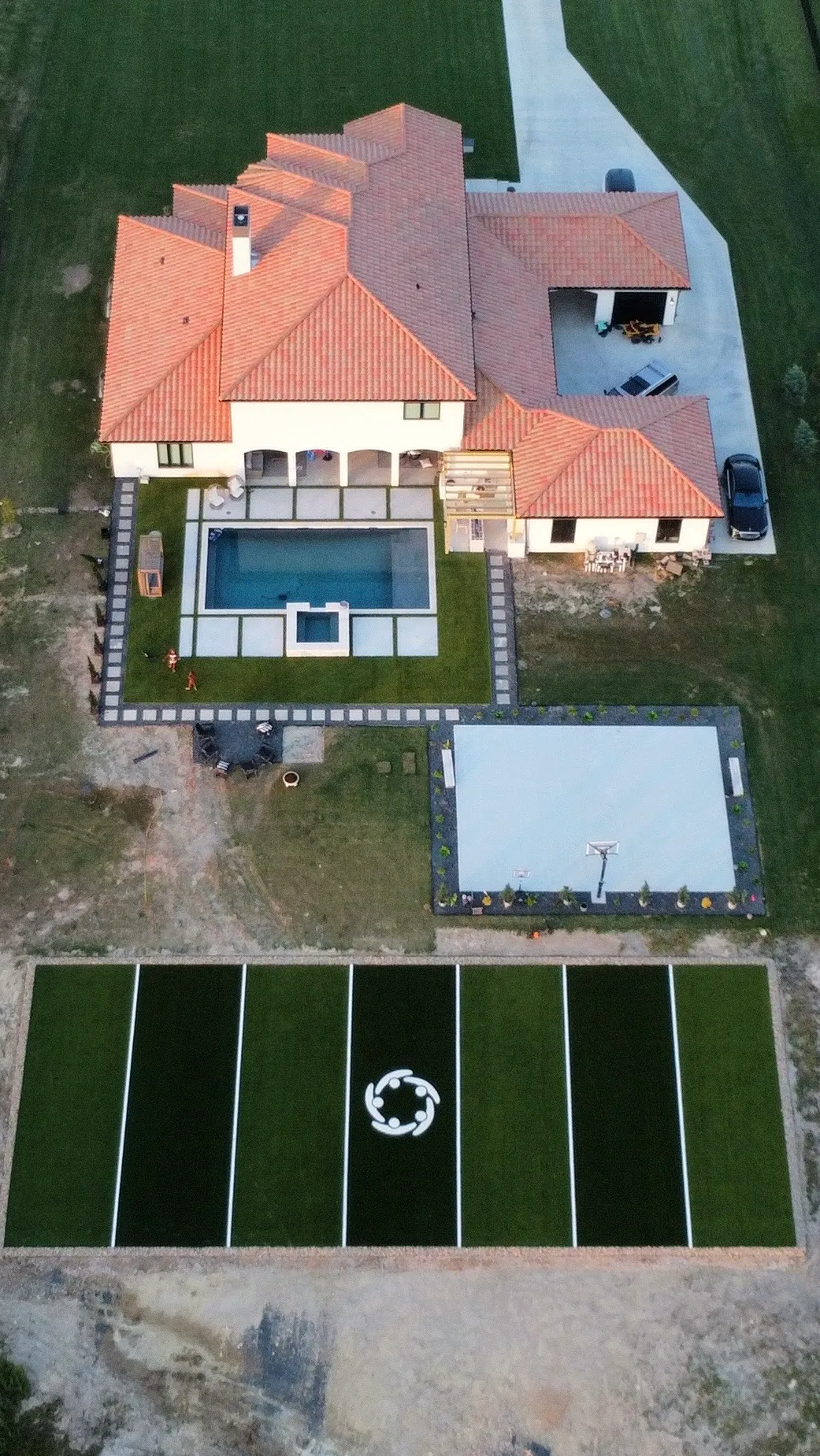
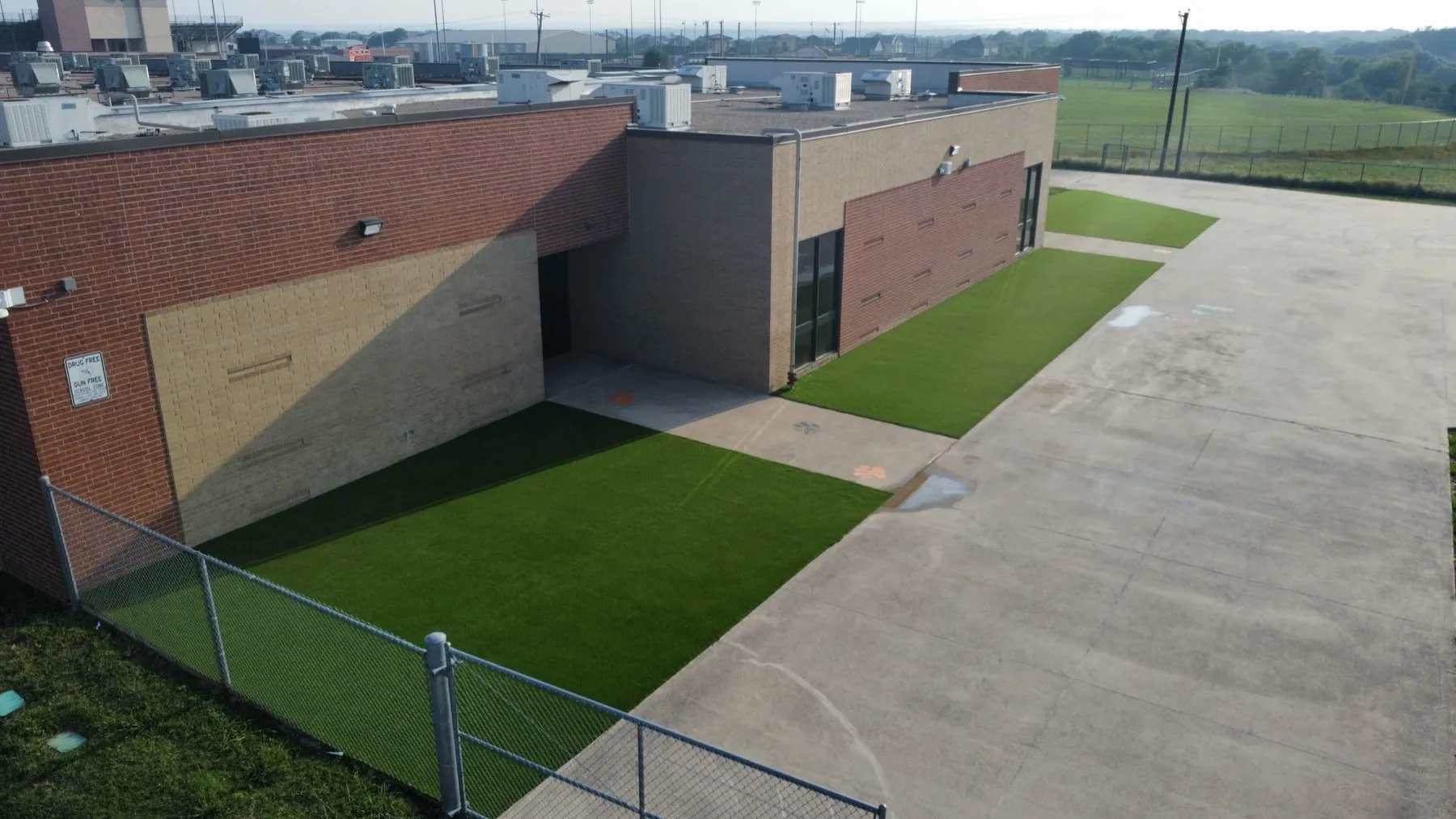
How we'd build a full multi-sport field.
For full-scale field builds — the kind of project that runs 200,000 square feet and has to drain like a parking lot under a Texas thunderstorm — this is the build standard we'd put into an ITB or RFP response:
- Subgrade prep per geotechnical report, stabilized, balanced, and compacted to +/- one tenth.
- 1,900 LF of 12″ x 12″ reinforced concrete perimeter curb with 2x4 composite turf-attachment nailer.
- Impermeable sub-grade liner tied to a synthetic-turf collector system (880 LF of 18″ and 1,900 LF of 12″ HDPE N-12 perforated pipe, washed #57 drain stone) and a 24″ solid stub-out for storm tie-in.
- 6″ drain stone layer over sub-grade, laser-graded to finished elevations.
- Schmitz EcoSport performance pad on stone base, with Shaw Sports Turf Legion Pro 2.00 carrying multi-sport ASC markings (11v11 red, 9v9 blue, 7v7 yellow) and a sand-and-rubber infill.
- Shaw 8-year manufacturer warranty, SMG 1400 tow-behind maintenance equipment delivered to the owner, staff training, and the Shaw Sports Turf maintenance manual.
Insurance, payment bonds, and performance bonds provided as required. Full line-item scope lives on our field specifications page — that's the document we hand to architects, athletic directors, and procurement officers when they're drafting an RFP at this scale.
Don't have full-project budget yet? Convert it in phases.
Most programs don't have the entire conversion budget approved in one board vote. We build fields in phases all the time — each phase uses the same base prep and turf spec as the next, so nothing gets torn out and redone when the budget catches up.
- Phase 1 — Bullpens & on-deck circles. The lowest-cost entry point. A single backyard-scale bullpen starts around $4,000–$9,000 (see our bullpen & pitching mound page); a program-scale bullpen area with multiple mounds is quoted per-project.
- Phase 2 — Infield conversion. Mound, plate, and basepaths — the skinned area that takes the most wear and the most rainout risk. Typically $80,000–$180,000 as a standalone conversion (see the full breakdown on our youth field cost page).
- Phase 3 — Full infield + outfield. The complete surface conversion, built on the same base and drainage work from Phase 2 — no rework. Typically $250,000–$600,000 for a standard youth field.
This is also the path we recommend for ISD and municipal programs working multi-year capital budgets — we'll size each phase as its own fixed-price scope so it's easy to bid and approve on its own.
Who we work with.
Youth leagues, select and travel organizations, school districts, parks departments, and private academies across the Dallas-Fort Worth metroplex and Tarrant, Dallas, Collin, Denton, Parker, and Wise Counties. We are a HUB Certified, family-owned business and we bid public and private projects alike.
Straight talk
A field conversion is a real capital project. It deserves more than a phone-call quote. We'll walk the field, review your drainage and subgrade, meet with your board or athletic director, and send a proposal with a clear scope and timeline.
Phased conversion FAQ.
Can we convert our field in phases instead of all at once?
Yes — this is how most budget-constrained programs approach it. A common sequence is bullpens or on-deck circles first, then the infield (mound, plate, basepaths), then the outfield later once the budget cycle allows. Each phase uses the same base prep and turf spec, so nothing gets redone when you move to the next phase.
Does phasing cost more than converting the whole field at once?
Not for the base and drainage work you build first — that part doesn't get redone. You do lose a bit of mobilization efficiency versus one single project, and material/labor pricing can shift between phases. For ISD and municipal programs working multi-year budget cycles, phasing is usually the only realistic path to a full conversion, and we'll size each phase so it stands on its own.
Before you commit
Run your own numbers with the ROI Calculator →
Tune the inputs for your facility: investment, maintenance savings, rentals, tournaments, concessions, and turf lifespan. See the payback period and 10-year return for your program.