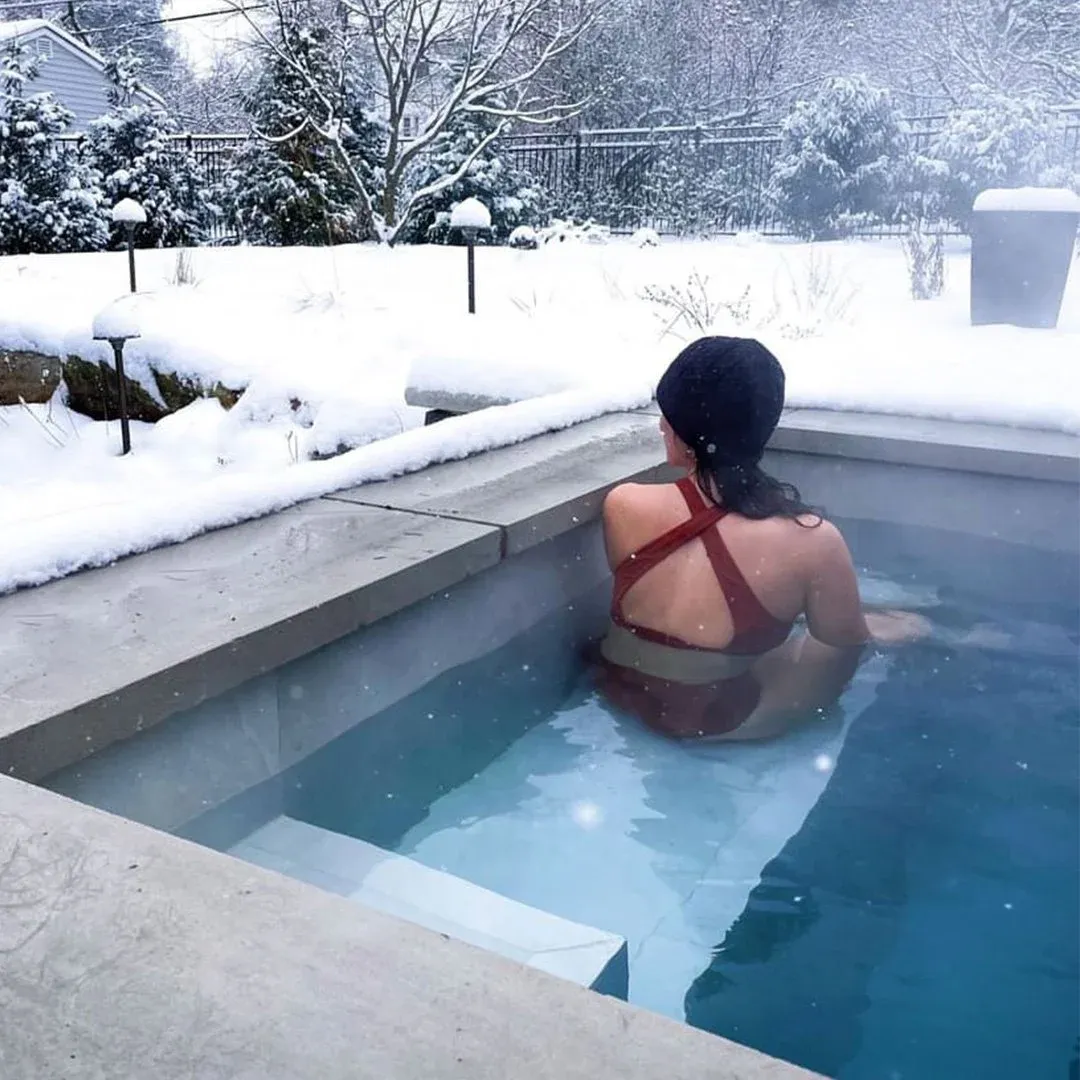
Every pool conversation in North Texas eventually hits the same wall: the season. Dallas–Fort Worth gives you brutal 100°F-plus summers, and then it gives you January. Real cold snaps, the occasional ice storm, weeks where the last thing anyone wants is a cannonball into 50°F water.
So the default DFW pool, a 15,000 to 25,000 gallon gunite build, ends up being a five-month amenity. It is too expensive to heat in winter, and by late July the sun has turned the shallow end into bath water anyway. You paid six figures for something that is actually pleasant to swim in from roughly May to September.
A precast concrete plunge pool flips that math. Because it holds a fraction of the water, you can afford to move its temperature in both directions: chill it against the August heat, and heat it to hot-tub temperatures when a norther blows through. One water body that works in every month of the Texas calendar.
We install Soake precast plunge pools across DFW as a Soake Pools Preferred Partner, so yes, we have a preference. But the argument below is physics and utility rates, and you can check every step of it.
Why nobody heats a gunite pool in Texas
Heating water is one of the most honest calculations in home ownership. Water takes 8.34 BTUs to raise one gallon by one degree Fahrenheit. There is no clever product that changes that number. The only lever you have is how many gallons you are heating.
Take a typical DFW backyard gunite pool at 20,000 gallons, sitting at 55°F in January, and say you want it at a swimmable 80°F:
20,000 gallons × 8.34 BTU × 25°F = about 4.2 million BTUs, just to get there once.
Through a typical gas pool heater, that initial warm-up alone is roughly 50 therms of natural gas, call it $60 to $80 at DFW rates. And that buys you exactly one warm-up. The pool then loses heat continuously across 400-plus square feet of open water surface, all night, every night, so holding 80°F through a Texas winter week typically runs hundreds of dollars a month. This is why nearly every gunite pool in the metroplex sits cold and covered from November to March: not because it can’t be heated, but because nobody wants to pay for it twice.
The same math on 3,200 gallons
Now run the identical calculation on the largest Soake model, the Full Plunge at 7’×13’ and 3,200 gallons. And since this pool is designed to double as a hot tub, let’s not stop at 80°F. Take it from 55°F all the way to a hot-soak 102°F:
3,200 gallons × 8.34 BTU × 47°F = about 1.25 million BTUs.
Read that again. Heating the plunge pool by 47 degrees takes less than a third of the energy of heating the gunite pool by 25. That is roughly 15 therms of gas, a $20-something warm-up, for water that is genuinely hot-tub hot in January.
| 20,000-gal gunite pool | 3,200-gal Soake Full Plunge | |
|---|---|---|
| Target in January | 80°F (swimmable) | 102°F (hot tub) |
| Energy for one warm-up | ~4.2 million BTU | ~1.25 million BTU |
| Open water surface losing heat | 400+ sq ft | 91 sq ft |
| Insulation | Bare shell in the ground | Factory insulation package, standard |
| Realistic winter habit in DFW | Cold and covered | Heated and used |
And the warm-up is the small half of the story. Ongoing heating cost is driven by heat loss, and heat loss is driven by surface area. The gunite pool bleeds heat across 400-plus square feet of open water. The Full Plunge exposes 91 square feet, arrives with an insulation package as standard equipment, and takes a safety cover that seals the whole surface. Smaller volume to reheat, four-plus times less surface losing it, and insulation holding it: that is why keeping a plunge pool at soak temperature all winter costs a fraction of what merely visiting 80°F costs a full-size pool.
The smaller models push the math even further. The Medium Plunge holds 2,100 gallons and the Square Plunge holds 1,000, at which point winter heating is closer to hot-tub economics than pool economics.
The summer half: chilled water in August
Everyone forgets the other direction. By August, a shallow DFW pool can crest 90°F, which is not refreshing, it is soup. Chilling 20,000 gallons is technically possible and practically unheard of: same physics, same problem, nobody does it.
Chilling 3,200 gallons is a normal Tuesday. A heat pump running in reverse (or a dedicated chiller) can hold a plunge pool in the 60s and 70s through the worst of a Texas summer, which turns your backyard into the thing everyone actually wants in August: genuinely cold water. Soake’s Cold Plunge model ships with a chiller as standard equipment, and the larger models take chilling equipment as an add-on.
So the year looks like this:
- June through September: chilled plunge pool, 65°F to 78°F, the coldest water on the block.
- October and April/May: ambient. The concrete and insulation keep it comfortable with no equipment running.
- November through March: heated to anywhere from swimmable to a 102°F hot soak. Steam coming off the water while the yard is frosted.
One pool, one equipment pad, one app. No separate $10,000 to $20,000 hot tub squatting on the patio, no second set of chemistry to maintain.
What runs it: your equipment options
Every Soake ships with the full Jandy equipment package: variable-speed pump, cartridge filter, salt chlorine generator, LED lighting, and app-controlled automation. Temperature control is the choice you make on top, and it is the one decision that shapes how you will actually use the pool:
- Gas heater: the sprint option. Fastest warm-up, ideal if your pattern is “heat it Friday afternoon, soak all weekend.” Needs a gas line run to the equipment pad.
- Electric heat pump: the marathon option. Slower to raise temperature but far cheaper per degree to hold one, ideal for keeping the pool ready all season.
- Heat/chill heat pump or chiller: the full year-round setup, heating in January and chilling in August with the same unit or a paired one.
Which one fits depends on your gas availability, your electrical panel, and honestly your personality: sprinters and marathoners own pools differently. This is exactly the conversation to have before the pool is ordered, because the equipment pad, gas run, and electrical are all part of the install we scope.
Talk through the heating and chilling options
This is the part we enjoy. Bring us your yard and your winter-use ambitions, and we will spec the temperature-control setup that fits, alongside the model, the site plan, and a fixed-price install proposal. The site walk is free, and it starts with a free Google Earth review of your lot: check your yard’s crane access with our free crane access and site assessment.
Request a free site walk or call 817-803-1445. Ask us what 102°F in January actually costs to run. We love that question.