Tennis court turf · Fort Worth & DFW
Tennis court artificial turf in Fort Worth.
Resurface a cracked hard court with sand-filled tennis turf. Convert an unused court into pickleball, a putting green, or an open turf space. Or build a new backyard court from the pad up. We install across Fort Worth, Dallas, and the full DFW metroplex.
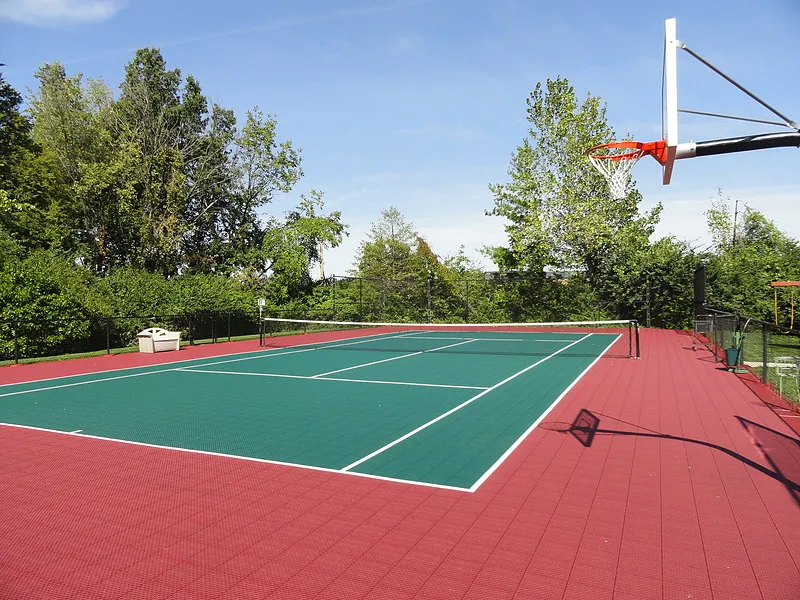
Three ways we put turf on a tennis court
- Resurface an existing court for tennis. Your slab is fine, your acrylic surface isn't. We repair cracks and low spots, then install sand-filled tennis turf over the existing concrete or asphalt with inlaid playing lines. You keep your court, lose the resurfacing cycle, and gain a surface that's dramatically easier on joints. Most resurfaces finish in under a week.
- Convert an unused court into something you'll actually use. The most common call we get about tennis courts. A full court footprint is about 7,200 square feet of paid-for concrete: room for two pickleball courts, a putting green, a batting cage, a shooting key, or a clean turf lawn, in whatever combination fits your family. Because the pad already exists, conversions cost a fraction of building any of those from bare dirt.
- Build a new backyard court. Pad, surface, net posts, fencing, lighting conduit, and integration with the rest of the yard so it doesn't read as a parking lot. New construction is a bigger scope (most of the budget is the concrete pad) and is always quoted from a site visit. See the sports courts page for the full build package.
What tennis court turf actually is
Tennis turf is not landscaping turf with lines painted on it. It's a purpose-built, sand-filled sports surface, and the spec matters:
- Pile height: 1/2" to 3/4", short and dense so the ball bounces true instead of dying in the fibers.
- Fiber: fibrillated or texturized polyethylene, engineered to lock sand in place and stand up to lateral footwork without shredding.
- Sand infill: kiln-dried silica sand brushed in nearly to the blade tips. The sand is what the ball actually plays off, and the fill level tunes court pace: more sand plays faster, deeper exposed pile plays slower.
- Inlaid lines: playing lines are cut in and seamed as separate white (or blue, for pickleball) turf strips, not painted. They never wear off.
- Drainage backing: perforated backing lets rain pass through, so the court is playable shortly after a storm instead of puddling like acrylic.
Play-wise, sand-filled turf sits in the medium to medium-slow pace range with a slightly lower bounce than a hard court. The trade most players are happy to make: the surface has give. Knees, hips, and lower backs feel the difference by the second set, which is why turf conversions are so popular with club players who want to keep playing for another twenty years.
Installation over an existing court
Slab assessment first. Turf hides surface cracking, but it can't fix structural movement. We inspect the slab, fill and level cracks and birdbaths, and grind any lifted joints. If the court has serious heaving (common with older non-post-tension slabs in North Texas clay), we tell you before quoting, not after installing.
Then the surface. Turf is rolled out, seamed, and glued or perimeter-anchored to the slab. Lines are inlaid, then sand is spread and power-brushed into the pile in multiple passes. A full-court resurface typically takes 3 to 5 working days depending on slab prep.
Maintenance afterward is minimal. An occasional drag-brush to redistribute sand, a top-up every few years, and a blower for leaves. No crack filling, no recoating every four years, no repainting lines.
What it costs
- Resurface an existing full-size court (about 7,200 sq ft): $30,000 to $55,000 with inlaid lines and minor slab repair included.
- Convert a court to a multi-sport space: $25,000 to $60,000 depending on the mix (pickleball lines, putting green, cage, open lawn) and how much of the footprint gets covered.
- New backyard court from bare ground: starts around $100,000, most of which is the concrete pad, fencing, and site work rather than the turf itself. Always quoted from a site visit.
Every quote is free, itemized, and usually back to you within 24 hours of the site visit. We're HUB Certified for school district, city, and county work, W-9 and COI ready.
Service area: Fort Worth, Dallas, and DFW
Bearcat is Aledo-based and installs court turf across the full metroplex: Fort Worth, Arlington, Mansfield, Burleson, Granbury, Weatherford, and Aledo on the west side; Southlake, Colleyville, Keller, and North Richland Hills in north Tarrant; Dallas proper, Frisco, McKinney, and Plano quoted and scheduled with a slightly longer lead time than our core Tarrant footprint. Travel is included in the quote for most DFW locations.
Frequently asked questions
Can you put artificial turf on a tennis court?
Yes. Sand-filled turf is a recognized tennis surface and a standard way to resurface an aging hard court. It goes down over the existing slab with inlaid lines and brushed-in silica sand.
How much does it cost to resurface a tennis court with turf?
$30,000 to $55,000 for a full-size court footprint in the Fort Worth area, including lines and minor slab repair. Smaller courts and partial footprints cost less.
How does turf play compared to a hard court?
Medium to medium-slow pace with a slightly lower bounce, tunable by sand level. The big win is underfoot: far easier on knees, hips, and backs than acrylic over concrete.
Can an old court be converted to pickleball or something else?
Yes. A tennis footprint fits two pickleball courts, or a mix of putting green, batting cage, basketball key, and open turf. Conversions are our most-quoted tennis court project.
How long does a turf court last in Texas heat?
10 to 15 years with basic upkeep. The sand infill shields the fibers from UV and traffic, and maintenance is brushing and occasional sand top-ups rather than recoating cycles.
Get a working number
What would artificial turf cost for your tennis court project?
Three quick questions. Real price range for your project in under a minute. No email required to see the number.
Run the Calculator →