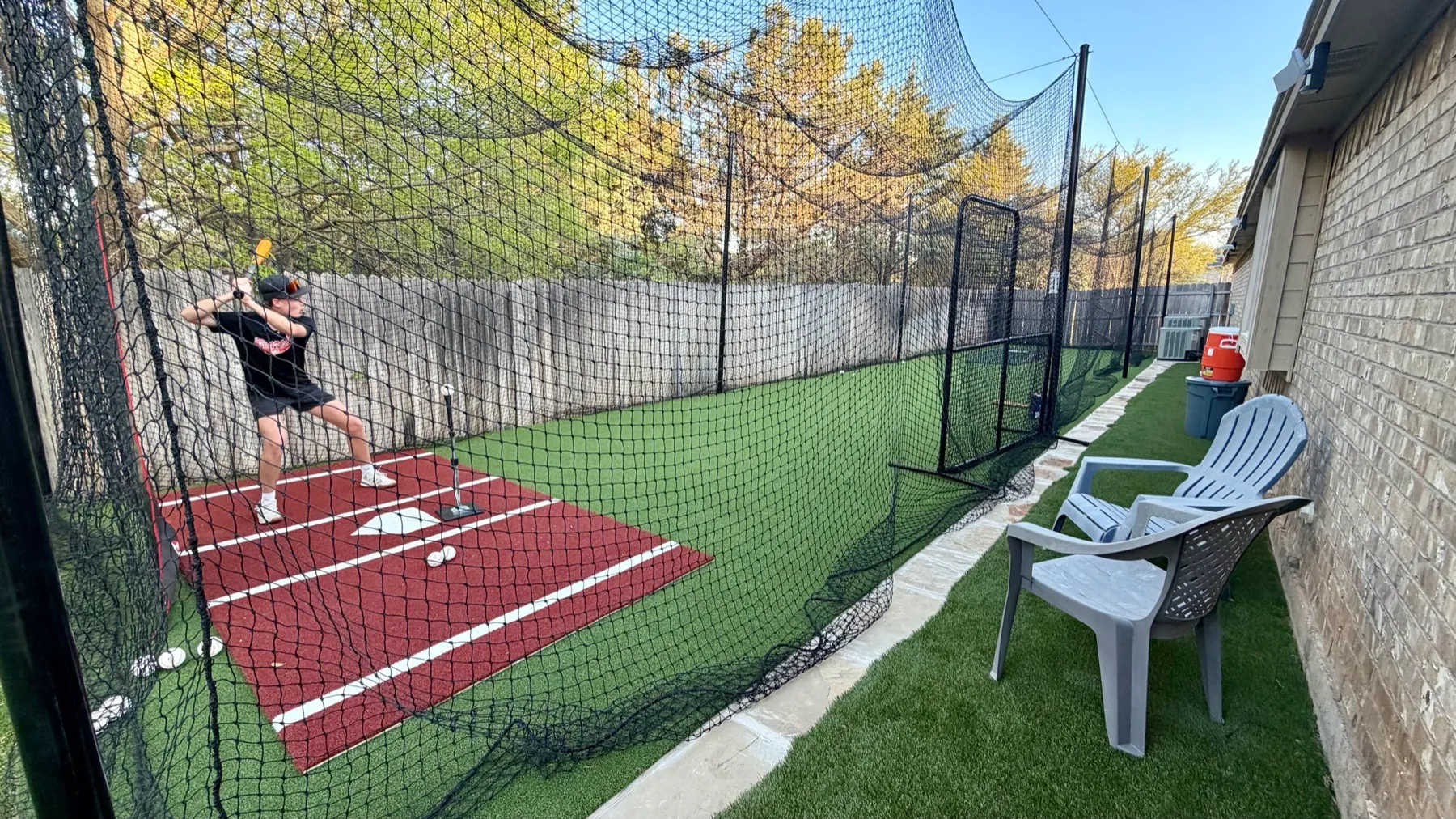
Batting cage turf guide
What turf should you use in a batting cage?
Three decisions cover it: fiber (nylon vs polyethylene), face weight (36 oz vs 42+ oz), and backing (foam-backed vs infilled). Here is how a DFW cage builder actually specs them, plus the wear-zone truth no product page mentions.
Cimarron-authorized cage installer · BBB Accredited · Bonded · Insured · Aledo, TX
Decision 1: fiber
Nylon vs polyethylene.
Nylon is the stiffest and most abrasion-resistant fiber made for sports turf. It springs back under machine volume, which is why it has long been the commercial-facility default, and it costs slightly more for it. Polyethylene is softer, gives a truer ball roll for fielding work, and is easier on knees over a long session, which makes it the standard for multi-use training spaces.
| Nylon | Polyethylene | |
|---|---|---|
| Feel underfoot | Stiff, firm | Softer, more forgiving |
| Abrasion resistance | Highest of any fiber | Good, better when texturized |
| Fiber recovery under volume | Springs back fastest | Slower to recover in wear zones |
| Ball roll for fielding work | Fast, can skid | Truer, more grass-like |
| Knee and joint comfort | Harsher on long sessions | More comfortable |
| Typical use | Commercial-facility default | Standard for multi-use spaces |
| Relative cost | Slightly pricier | Lower for comparable weight |
The short version: high-volume hitting zones want nylon or a heavy texturized poly. Multi-purpose training floors, where the same surface hosts hitting, fielding, and agility work, want poly. Market-wide, cage-grade turf runs roughly $1.25 to $3.00 per square foot in materials depending on fiber and backing, so the fiber call is a real budget lever on a big footprint.
Decision 2: face weight
36 oz vs 42+ oz.
Face weight is the ounces of fiber per square yard. More fiber means a denser, more durable face that takes longer to matt down where cleats pivot in the batter's box. It is the single clearest number on a cage turf spec sheet, and the one most worth matching to your actual swing volume.
| 36 oz texturized | 42+ oz (or nylon) | |
|---|---|---|
| Fiber density | Solid for the weight class | Denser, fuller face |
| Batter's box matting | Matts sooner under daily volume | Slower to matt down |
| Right-sized volume | Family and backyard cages | Team facilities, lesson businesses |
| Cost | Lower material cost | Higher, buys durability |
A 36 oz texturized product holds up for family and backyard volume: one or two hitters a night, weekend machine sessions, travel-ball reps. Once a cage is a business, a team facility running stations, or a lesson operation cycling hitters all day, step up to 42+ oz or nylon and let the extra fiber absorb the volume.
Decision 3: backing
Padded (foam-backed) vs unpadded infilled.
Foam-backed, non-infill rolls (typically a 5mm pad bonded to the turf) are the standard for indoor cages: consistent cushion everywhere, no infill migrating into the netting or pitching machines, and a faster glue-down install over concrete. Infilled turf earns its place outdoors, where a compacted stone base handles drainage and the infill ballasts the surface against Texas weather.
| Foam-backed, no infill | Unpadded, infilled | |
|---|---|---|
| Cushion | Built-in, consistent everywhere | Comes from infill depth and base |
| Infill | None: nothing migrates into nets or machines | Sand or rubber, needs top-ups |
| Install over concrete | Direct glue-down, fast | Not the right system for a slab |
| Drainage | Indoor spec, drainage not a factor | Drains through backing to stone base |
| Where it belongs | Indoor cages: the standard | Outdoor cages on stone base |
The wear-zone truth: your batter's box dies first.
No matter what you spec, cage turf does not wear evenly. The batter's box and the catcher/plate zone take every pivot, dig-in, and dragged toe, and they will matt down years before the rest of the cage shows any wear at all. The open lanes can look nearly new a decade in while the box is flat.
You have two honest options. One: spec a heavier product cage-wide (42+ oz or nylon) and accept that you are buying durability for the whole floor to protect two small zones. Two: spec the floor for the floor's volume and plan replaceable batter's box mats at the plate, so the wear point becomes a cheap, swappable part instead of a re-carpet trigger. We walk through the second approach in detail in our guide to turfing a batter's box and pitching mound.
Indoor vs outdoor cage turf: three real differences.
- Drainage. Outdoor cages need permeable turf over a compacted stone base so North Texas storms pass through instead of ponding in the lane. Indoor cages over a slab skip drainage entirely, which is what makes the foam-backed glue-down build possible.
- UV exposure. Outdoor turf needs UV-stabilized fiber rated for full Texas sun or the face fades and embrittles early. Indoor product can put that budget into face weight instead.
- Base. Outdoor means excavation, stone, and compaction. Indoor means the concrete you already have. If you are still deciding on the structure itself, see our metal building cage guide and warehouse cage buildout page.
What Bearcat specs, and why.
In hitting zones we spec Performance Pro: a 36 oz texturized fiber on a foam-backed system. Texturized fiber resists matting better than a straight fiber at the same weight, and the bonded foam backing delivers the cushion and no-infill install that indoor and pad-based cages want. It is the balance point we keep landing on across backyard, school, and facility cage builds in DFW.
As the Cimarron-authorized cage installer for DFW, we quote the turf and the cage as one build: frame, net, and surface from one crew under one warranty. Start with our pre-priced cage packages, or see the full local picture on our batting cage turf Fort Worth page. Building a bigger training floor around the cage? That is our training facility turf scope. And if you are still deciding between individual tunnels or one shared shell net, we wrote that up too.
Batting cage turf questions, answered.
Should I use nylon or poly turf in a backyard batting cage? +
For most backyard cages, a heavy texturized polyethylene is the right answer: softer underfoot, more comfortable for long sessions, and durable enough for family and travel-ball volume. Nylon earns its premium when the cage will see machine work every day, multiple hitters back to back, or lesson traffic. If your cage doubles as a fielding or training space, poly wins on feel and ball roll.
What does 36 oz vs 42 oz turf actually mean? +
Face weight is the ounces of fiber per square yard of turf. A 42 oz product carries more fiber than a 36 oz product, so it is denser, wears longer, and takes longer to matt down in the batter's box. A 36 oz texturized turf holds up well under family and backyard volume; 42 oz and up (or nylon) is the spec for commercial volume like team facilities and lesson businesses.
Do I need padding under batting cage turf? +
Indoors over concrete, yes: a foam-backed roll (typically 5mm) is the standard build. It gives consistent cushion for knees and ankles, needs no infill, and installs directly to the slab. Outdoors on a compacted stone base, an unpadded infilled turf is usually the better system because the base itself provides give and the infill ballasts the turf against weather.
Can I put batting cage turf over concrete? +
Yes. Glue-down, foam-backed turf over a concrete slab is the standard indoor cage build: metal buildings, warehouses, barns, and garage conversions all use it. The foam backing supplies the cushion the slab cannot, there is no infill to migrate into netting or pitching machines, and installation is faster than any infilled system.
How long does batting cage turf last before the batter's box wears out? +
The honest answer is volume-dependent. The open lanes of a cage can look nearly new after a decade while the batter's box and plate zone matt down in 2 to 5 years under heavy use, or faster in a commercial facility. The smart strategy is planning for it: spec a heavier product cage-wide, or design the hitting zone around replaceable batter's box mats so a $200 swap resets the wear point instead of a full re-carpet.
Ready to pick a surface for a real cage?
Tell us who is hitting and where the cage is going. We will spec the fiber, weight, and backing to match, as part of a complete frame-net-surface build. Backyard cage packages install from $4K.
HUB Certified · BBB Accredited · Bonded · Insured · Aledo, TX