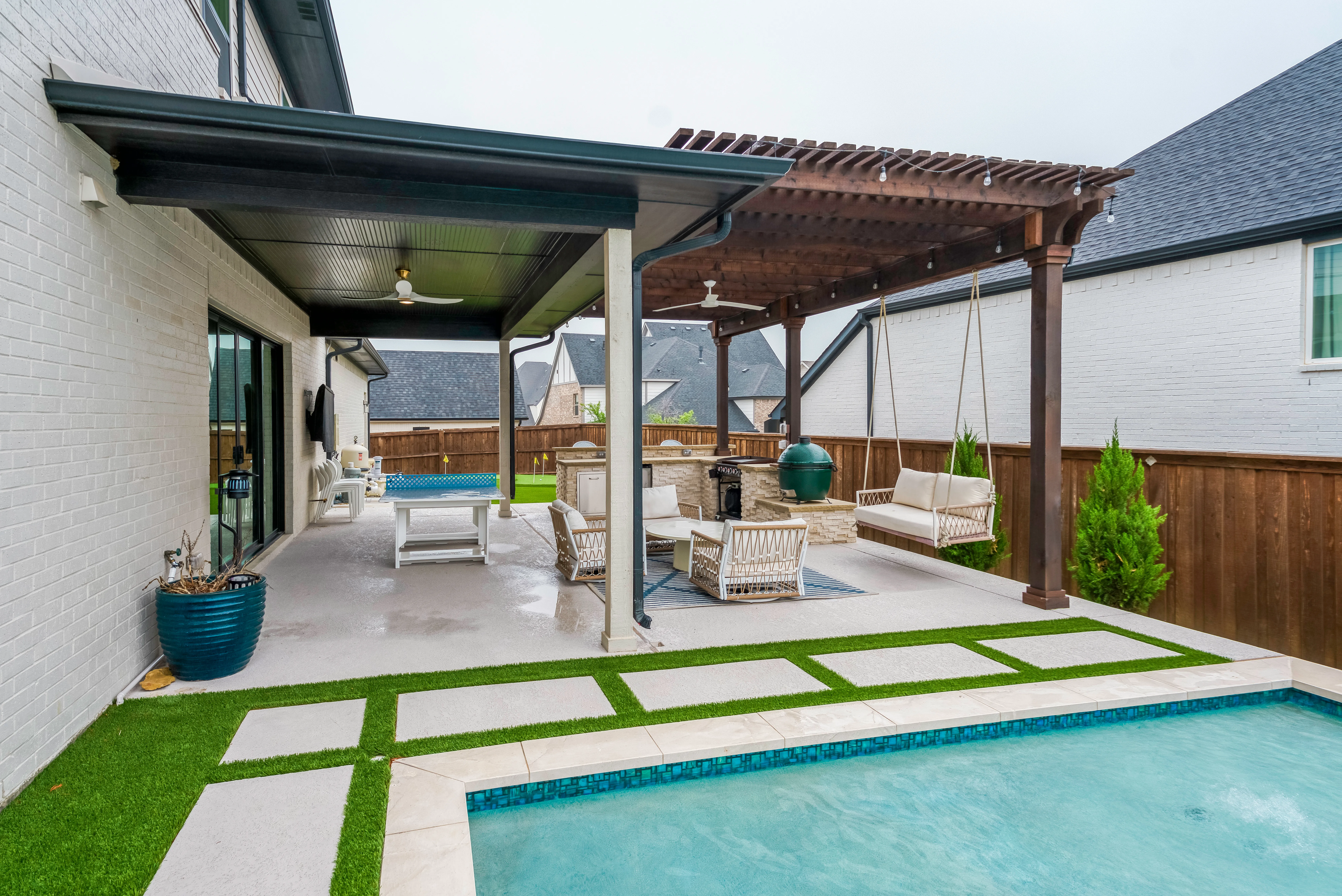
If you’ve scrolled a pool-deck design board in the last year, you’ve seen it: strips of green turf running between large-format pavers, or filling in the joints on a paver-look concrete deck. It’s one of the most-requested details we get right now on pool projects, and we get why. That green pop against stone or concrete reads as clean, modern, and finished in a way plain concrete doesn’t. We think it looks great too.
But there’s a gap between “put some turf strips in the deck” and doing it right, and that gap is where the cost lives. Here’s what actually drives the price on this detail, straight from the install side.
Every flatwork crew builds the deck differently
The first challenge has nothing to do with turf. It’s that we’re almost never the ones pouring the deck. A pool builder’s flatwork crew, or a separate concrete contractor, builds the deck to their own habits and their own spec, and we show up after to fill the joints. That means every job starts with the same question: how did this particular crew build this particular deck?
There’s no single standard, so we have to learn or adapt to whichever method the flatwork crew used, and that method determines how the turf install goes. Two examples we see constantly:
- Sometimes there’s no concrete between the squares or triangles at all. The joints where the turf goes are just raw dirt, left open on purpose so the “paver” look can get infilled later. That’s fine, except now we have to build that space up so the turf sits flush and level with the surrounding deck. That buildup takes base material and labor time that a job with a clean concrete joint doesn’t need.
- Sometimes there’s concrete in the joint, but it’s too low. Turf has real thickness, usually an inch to two inches with backing and infill. If the joint was poured an inch below deck height, that inch has to get filled in before turf ever goes down, or the strip sits like a shallow trench instead of flush with the deck.
Neither of these is wrong construction. They’re just two different ways to build the same look, and we don’t get to pick which one shows up on a given site. We adapt to it, and that adaptation is billable time and material, not a markup we’re tacking on for fun.
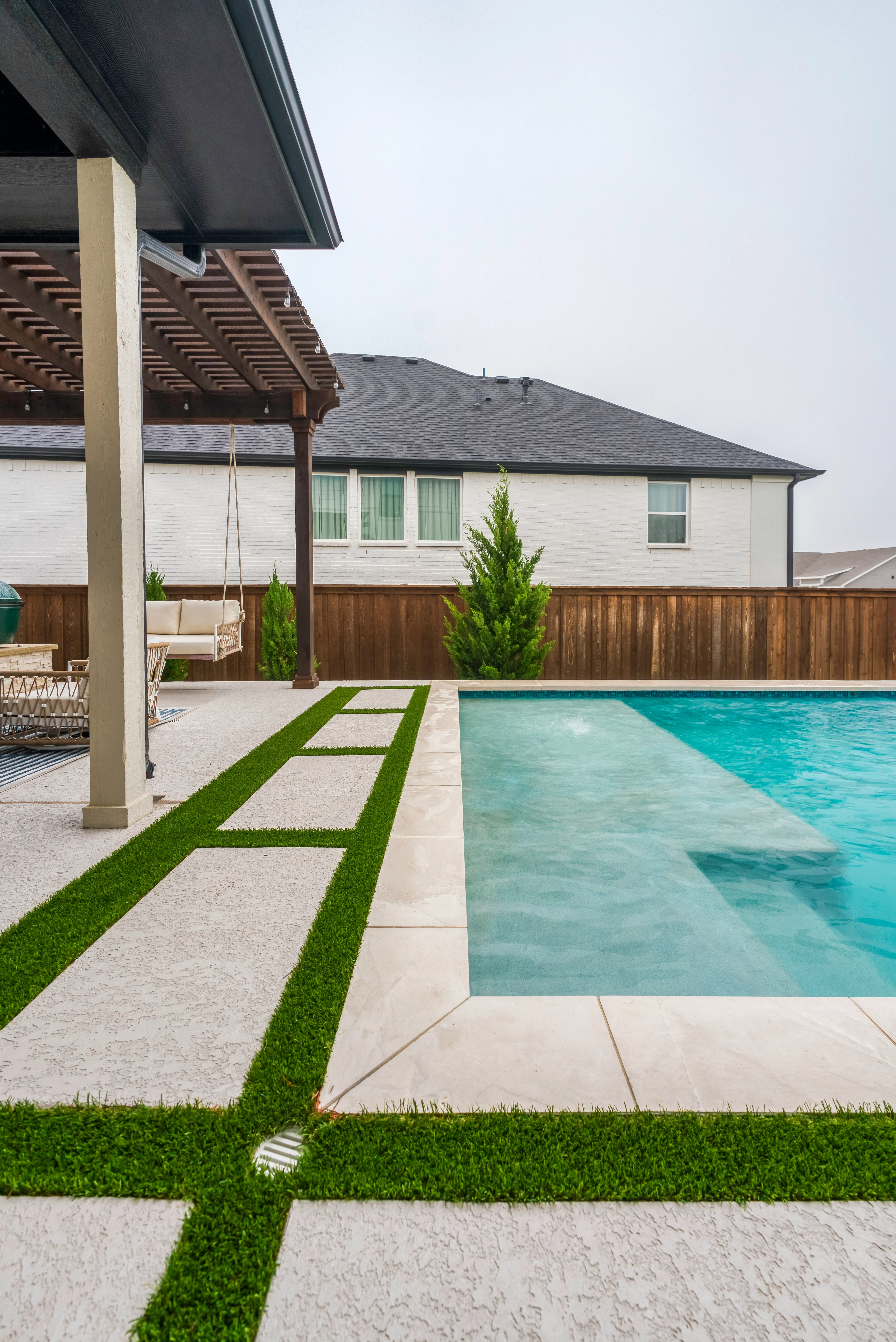 Turf strips flush against the coping on this DFW deck. Every strip in this grid had to land at the same finish height as the pavers around it, right down to the pool edge.
The self-leveling concrete and height math
When a joint comes in too low, the fix is self-leveling concrete, and it isn’t cheap. It also isn’t optional if you want the strip to actually sit flush instead of looking like an afterthought.
The harder part is that self-leveling concrete and turf height have to be solved together, not separately. We’re trying to land on a joint depth that, once we add turf on top, ends up just above the surrounding deck for that slightly proud, tailored look, but not so tall that it reads as a step or a trip hazard. That means picking the turf pile height first, then backing into how much self-leveling concrete the joint needs to hit the right finish elevation. Get the math wrong in either direction and you’re either grinding down cured concrete or ripping out turf to try a shorter pile. Both cost more than getting it right the first time.
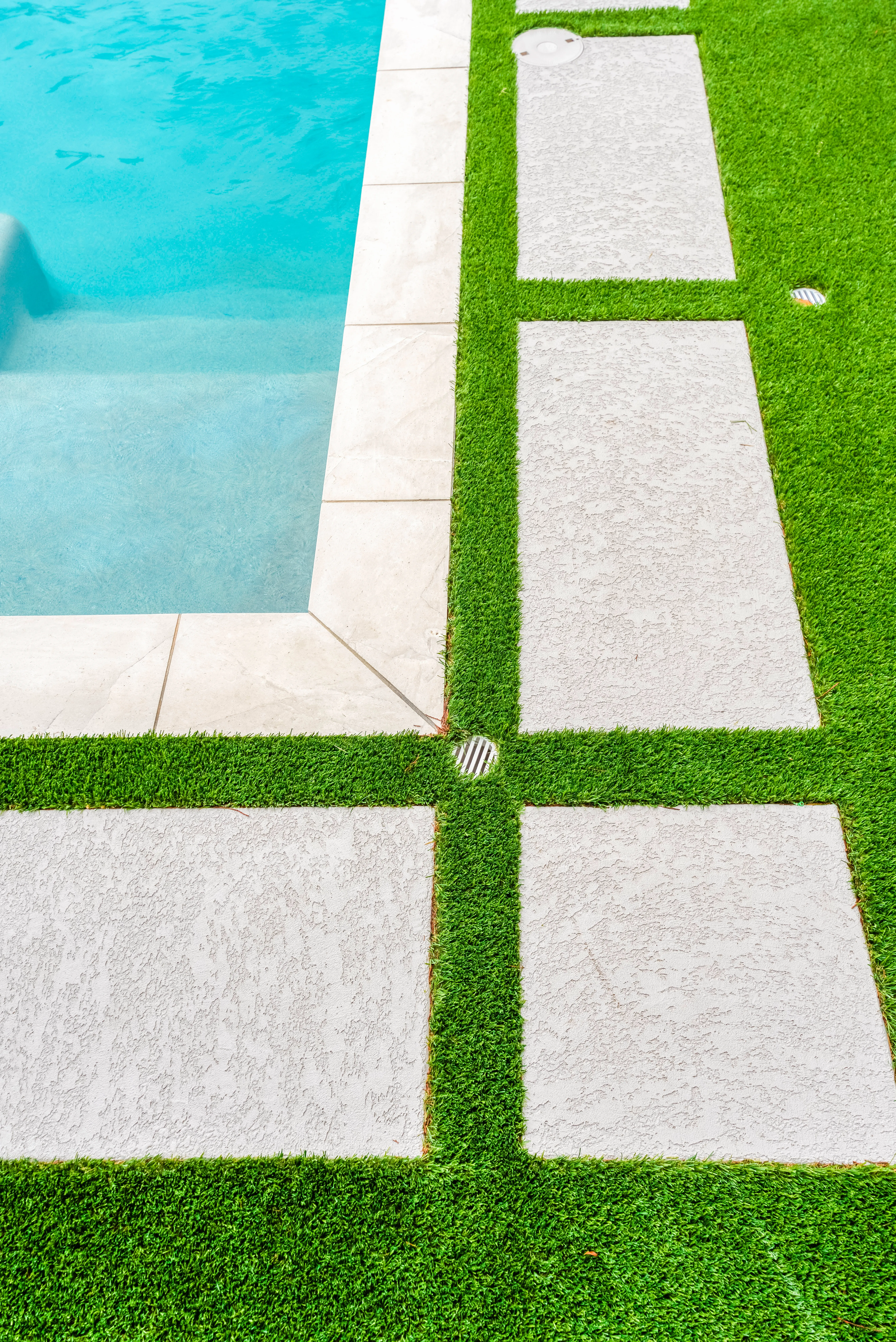 Every joint in a grid like this has to come out at the same height, drain covers included. That’s the self-leveling concrete and turf-height math working together, not a coincidence.
Why we glue instead of nail
Turf wants dirt. On a normal lawn or sport court base, we anchor turf with nails or staples driven straight through the backing into the ground below, which is fast and cheap. A paver-joint or deck-joint install doesn’t give us that option, because there’s concrete under the turf instead of dirt.
So every strip gets glued down instead. The adhesive turf installers use for concrete bonding isn’t the cheap stuff, and it isn’t optional; a strip that isn’t fully and evenly glued will lift at the edges over time, especially with pool water, sun exposure, and foot traffic working against the bond. That glue cost gets built into the price, and so does the extra care it takes to apply it evenly across a narrow strip instead of a wide open field, where a thin or inconsistent bead is much easier to miss.
What it actually costs
For reference, a standard backyard turf install runs $8 to $14 per square foot in DFW. Turf strips in a pool deck run higher: $15 to $20 per square foot, and now you know why. It’s a narrow-format install with concrete correction, self-leveling, and full-coverage glue built into every square foot instead of spread across a wide-open yard.
Where you land in that range comes down to one thing more than anything else: how well the deck was prepped before we ever show up.
- A deck poured with clean, consistent joints already at the right depth for turf lands toward the $15/sq ft end. There’s little to fix, so the cost is mostly material and glue-down labor.
- A deck with open dirt joints, inconsistent depths, or joints poured too shallow pushes toward $20/sq ft and beyond, because that’s where the self-leveling concrete, extra base buildup, and height-matching time show up.
That’s also why we push to get involved before the deck gets poured whenever we can. When we’re in the conversation early, on a Soake install or a custom pool build, we can tell the flatwork crew exactly what joint depth we need for turf, and the prep problems that push a job toward $20/sq ft never happen in the first place.
What this means for your quote
None of this is a reason to skip the detail. It still looks great, and it’s still one of the cleanest ways to bring green into a hardscape-heavy pool deck without giving up a full turf field. But when you’re comparing quotes in the $15-$20/sq ft range for turf strips in a paver or paver-look deck, know that the real cost drivers are:
- How the flatwork crew built the joints (open dirt vs. shallow concrete vs. a joint that’s actually the right depth) — this is the single biggest swing factor between $15 and $20+ per square foot
- Whether self-leveling concrete is needed to hit the right finish height, and how much
- The turf pile height that has to be picked to match that finish height
- Full-coverage concrete adhesive instead of nails or staples
A quote that skips past these questions is either guessing or hasn’t seen your deck yet. A quote that walks through them with you is doing the job right.
Building the whole backyard, deck included
This is exactly the kind of detail that goes smoother when one contractor is coordinating the pool deck and the turf, instead of a turf crew showing up cold to whatever the flatwork crew left them. We’re a Soake Pools Preferred Partner and we build turf surrounds and deck details on custom concrete pools across DFW, so we’re often in the conversation before the deck gets poured, not just after.
If you’re planning a pool deck with turf strips or a full turf surround, reach out for a site walk or call us at 817-803-1445 and we’ll tell you honestly what your specific deck build is going to take.
- Colin & Lindsey Burns Bearcat Turf & Outdoors · Aledo, TX