Custom sports netting · DFW & regional facility builds
Netting is its own trade. We treat it that way.
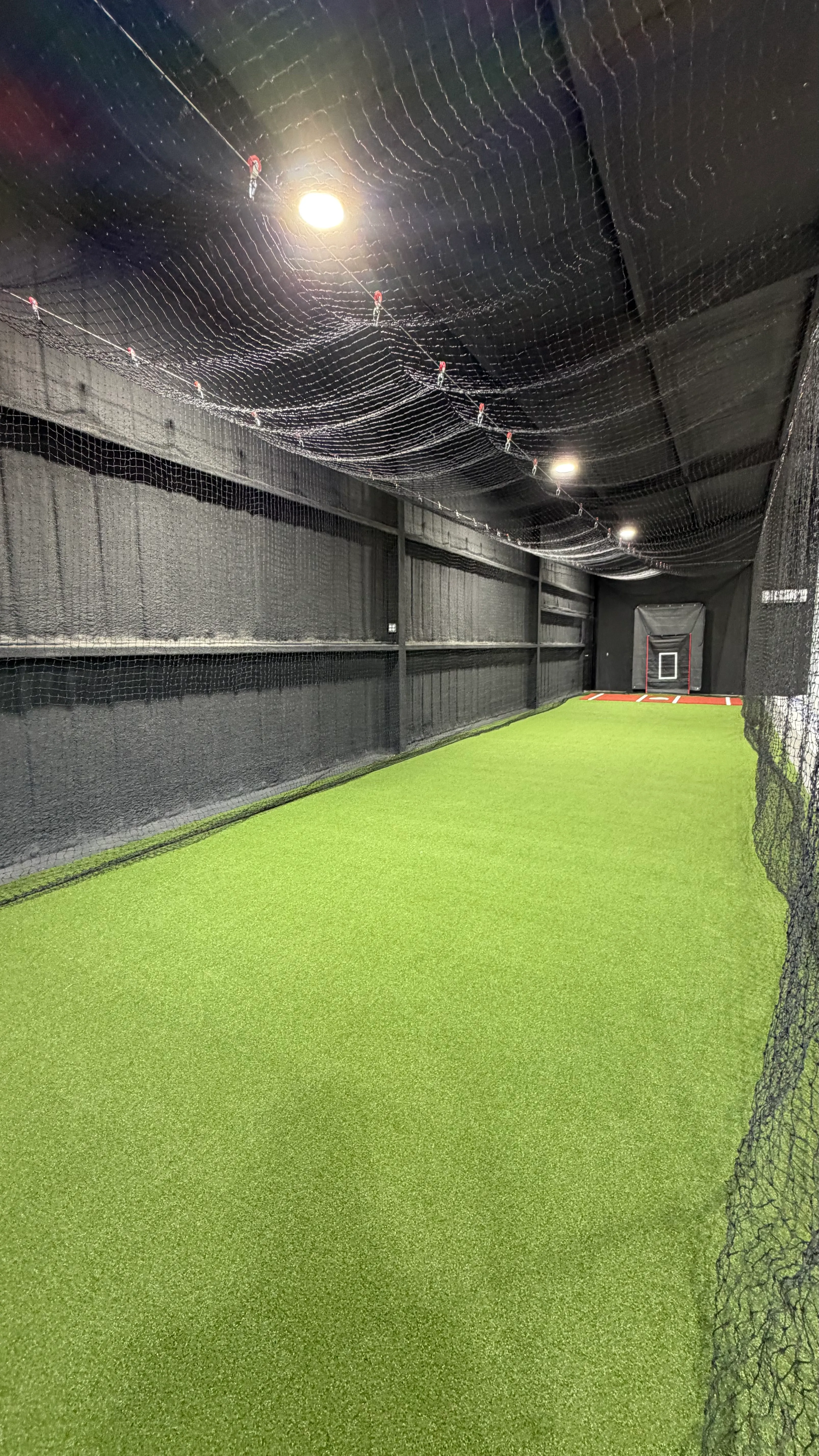
Ceiling-cable rigs hung from an existing building, retractable trolley systems, outdoor pole-mounted cages, and the frame and gauge engineering underneath all of it — batting cages, cricket nets, golf bays, and perimeter containment for larger facilities. Standalone netting is a DFW build; netting bundled into an indoor facility construction project travels across Texas, Oklahoma, Louisiana, Arkansas, Kansas, New Mexico, Nebraska & Georgia.
By application
Same trade, different sport.
Batting cages
Cage & lane netting
Steel-frame or cable-hung, #24 through #84 twisted poly by use intensity.
See net gauge specs →
Cricket
Cricket net enclosures
50mm knotted HDPE mesh sized for a bowler's run-up, single lane to multi-lane commercial.
See cricket net builds →
Golf
Practice nets & hitting bays
Freestanding practice nets or fully enclosed hitting bays with an impact screen.
See golf net builds →
Multi-sport facilities
Perimeter & ceiling netting
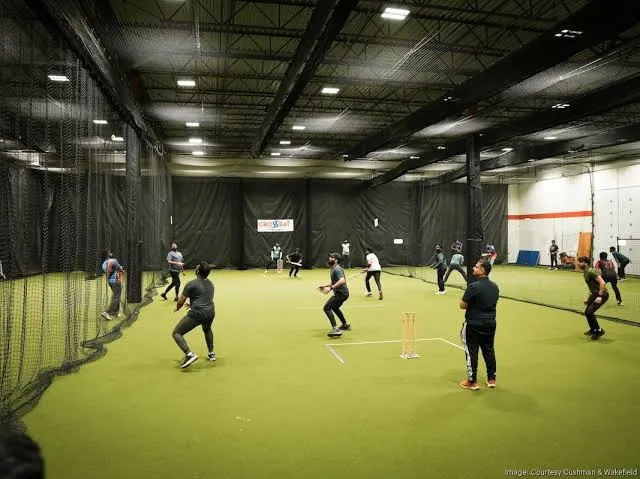
Containment netting for open turf spaces sharing a floor with cages or lanes, plus partition nets between stations.
See indoor facility construction →
Netting specs
Net gauge is the biggest lifespan variable.
Pick low, save money up front, replace the net in three years. Pick high, pay more up front, get fifteen years of use.
| Gauge | Twine | Best for | Typical lifespan |
|---|---|---|---|
| #24 | 1.4mm twisted poly | Tee work, soft toss, low-velocity, light use | 3-5 yrs (residential) |
| #42 | 2.4mm twisted poly | Backyard sweet spot — front toss, machine, live BP | 7-10 yrs (residential) |
| #45 | 2.7mm twisted poly | Commercial daily-use — school and academy standard | 8-12 yrs (commercial) |
| #60 | 3.5mm twisted poly | High-velocity machine work, college / pro programs | 10-15 yrs (commercial heavy use) |
| #84 | 4.0mm twisted poly | Pro-level facilities, maximum durability | 15+ yrs |
| Cricket mesh | 50mm knotted HDPE, 1.5-3.0mm | Sized to bowling speed and daily use | Varies by gauge |
What netting costs
Sports netting prices, installed.
Net prices are Cimarron's published minimum advertised prices, which is what we sell at. Installation is our crew. The one thing we do not price from a table is barrier netting, because a 40 ft pole in Oklahoma wind is a different structure from a 20 ft pole behind a Fort Worth backyard.
| Netting job | What the price covers | Price | |
|---|---|---|---|
| Replacement cage net, hung by our crew | Cimarron net at MAP plus hang and install | $1,099 to $2,059 | Price a net → |
| Complete backyard batting cage | Frame, net, install, turf hitting zone options | $5,999 to $12,199 | See packages → |
| Cricket net, backyard to full run-up | 35 to 70 ft steel-frame enclosure, pitch surface included | $9,000 to $20,000 | Cricket builds → |
| Golf practice net or hitting bay | Net and mat, or enclosed bay with impact screen | $3,500 to $16,000 | Golf nets → |
| Indoor facility netting, per tunnel | Cable-hung shell net, dividers, and hardware inside an existing building | Priced per tunnel in a facility scope | Facility packages → |
| Barrier and perimeter netting | Foul-ball, spectator, and property-line netting on poles or cables | Quoted per linear foot by height after a site walk | Request a quote → |
Replacing the net on a cage you already have.
The most common netting call we get. Your frame or cable rig is fine, the net is sun-rotted or torn. We size a Cimarron net to the frame, hang it, and tension it in a half day. Pick the gauge by how the cage is used, not by the old net: most backyard cages were sold with #24 and should be replaced with #42.
| Gauge | Use | Net only (MAP) | Hung by our crew |
|---|---|---|---|
| #24 | Light residential, tee and soft toss | $299 to $729 | $1,099 to $1,529 |
| #42 | Backyard machine and live BP | $509 to $999 | $1,309 to $1,799 |
| #45 | Commercial daily use, schools and academies | $809 to $999 | $1,609 to $1,799 |
| #60 | High-velocity machine work, college programs | $1,199 to $1,259 | $1,999 to $2,059 |
Net ranges span 30 ft to 70 ft lengths within each gauge. Hang and install assumes a sound existing frame or cable rig within DFW; new cables, hardware, or frame repair are quoted separately.
Foul-ball, spectator, and property-line barrier netting.
Barrier netting keeps balls off a parking lot, a neighbor's roof, or a bleacher. It is the highest-ticket outdoor netting we build and the one a table cannot price. The number comes from height, span, and wind: pole height sets the embedment and the pole section, span sets the cable and pole count, and the county's design wind speed sets both. We size posts, footings, cable tension, and net panel breaks to the site, and we tell you when a system needs to come down in severe-weather season rather than pretending it will ride it out. Send the span and height for a planning range, then we walk it and quote one fixed price.
How it's rigged
Ceiling cables, retractable trolleys, or outdoor poles.
Cable-hung from an existing structure
If the building has exposed rafters or purlins, we rig netting directly from the structure using cables — no freestanding frame required. Wood-frame barns, metal buildings, and post-frame structures all work; the netting load is distributed across multiple attachment points without cutting or compromising structural members, and the system is removable if you ever need it out completely.
Retractable cable-trolley systems
For buildings that need to double as something other than a cage or net bay, a cable-trolley system lets the netting retract out of the way and pull back into place for practice. It costs more than a fixed net on the same rigging — the trolley hardware and cable tensioning take more labor to get right — but it's the option that gives you both uses of the space.
Outdoor pole-mounted frames
Where there's no existing structure to hang from, the frame does the work. Cable/rookie frames are rated to about 50 mph. Steel-tube residential frames run 70 mph with proper anchoring. Commercial frames, ground-anchored or concrete-pier mounted, are rated to 90+ mph for outdoor commercial installs.
Netting FAQ
Common questions before you build.
How much does it cost to replace batting cage netting?
A replacement Cimarron cage net runs $299 to $1,259 at MAP depending on size and gauge, from a 30 ft #24 net to a 70 ft #60 net. Our crew hangs it on your existing frame or cable rig for about $800, so a typical replacement lands between $1,099 and $2,059 installed. If the frame or cables are also tired, we tell you before we hang a new net on them.
What does foul-ball or barrier netting cost?
Barrier netting is priced per linear foot, and the height drives it more than the length: a 20 ft property-line net on steel poles and a 50 ft foul-ball system behind a backstop are different structures with different footings and wind loads. We walk the site, size the poles and embedment for the wind in your county, and quote one fixed price for poles, cables, net, and hardware. Send us the span and the height you need and we will give you a planning range before the visit.
What netting gauge do I actually need?
It depends on use intensity, not just budget. #24 (1.4mm) suits light residential tee work and lasts 3-5 years. #42 (2.4mm) is the backyard sweet spot for front toss and machine work, 7-10 years. #45 (2.7mm) is the commercial daily-use standard for schools and academies, 8-12 years. #60 (3.5mm) handles high-velocity machine work and college/pro programs, 10-15 years. #84 (4.0mm) is pro-level, 15+ years.
Can you hang netting from an existing building instead of building a frame?
Yes — if the building has exposed rafters or purlins, we rig cage netting directly from the structure using cables, no freestanding frame required. Wood-frame barns, metal buildings, and post-frame structures all work; the load is distributed across multiple attachment points without cutting or compromising structural members.
What about a retractable system I can push out of the way?
We've built full retractable cable-trolley systems — a 70 ft barn cage in Aledo runs on a cable trolley so the family can retract the net and use the barn for non-baseball purposes, then pull it back into place for practice. It costs more than a fixed net on the same rigging, since the trolley hardware and cable tensioning take more labor to get right.
What wind rating do outdoor netting frames carry?
It depends on the frame tier. Cable/rookie frames are rated to about 50 mph. Steel-tube residential frames are rated to 70 mph with proper anchoring. Cimarron commercial frames, ground-anchored or concrete-pier mounted, are rated to 90+ mph for outdoor commercial installs.
Do you install netting for cricket, not just batting cages?
Yes — cricket nets use a different mesh (50mm knotted, UV-stabilized HDPE, 1.5-3.0mm twine gauge) sized for a bowler's run-up rather than a pitcher's mound, but the frame, rigging, and drainage-base approach are the same trade. See our dedicated cricket page for pitch and pricing detail.
Can netting be part of a larger facility build, not just a standalone cage?
Yes. Perimeter and ceiling netting for open turf spaces sharing a floor with cages or lanes, partition nets between multi-station bays, and containment netting for indoor soccer/football fields are all part of our indoor facility construction scope.
Have a netting project in mind?
Tell us the sport, the space, and how it needs to be rigged. We'll walk it and send a fixed-price proposal. Free site visit.
School, club, or facility project with an RFP or spec already in hand? Send it to our Spec Desk →