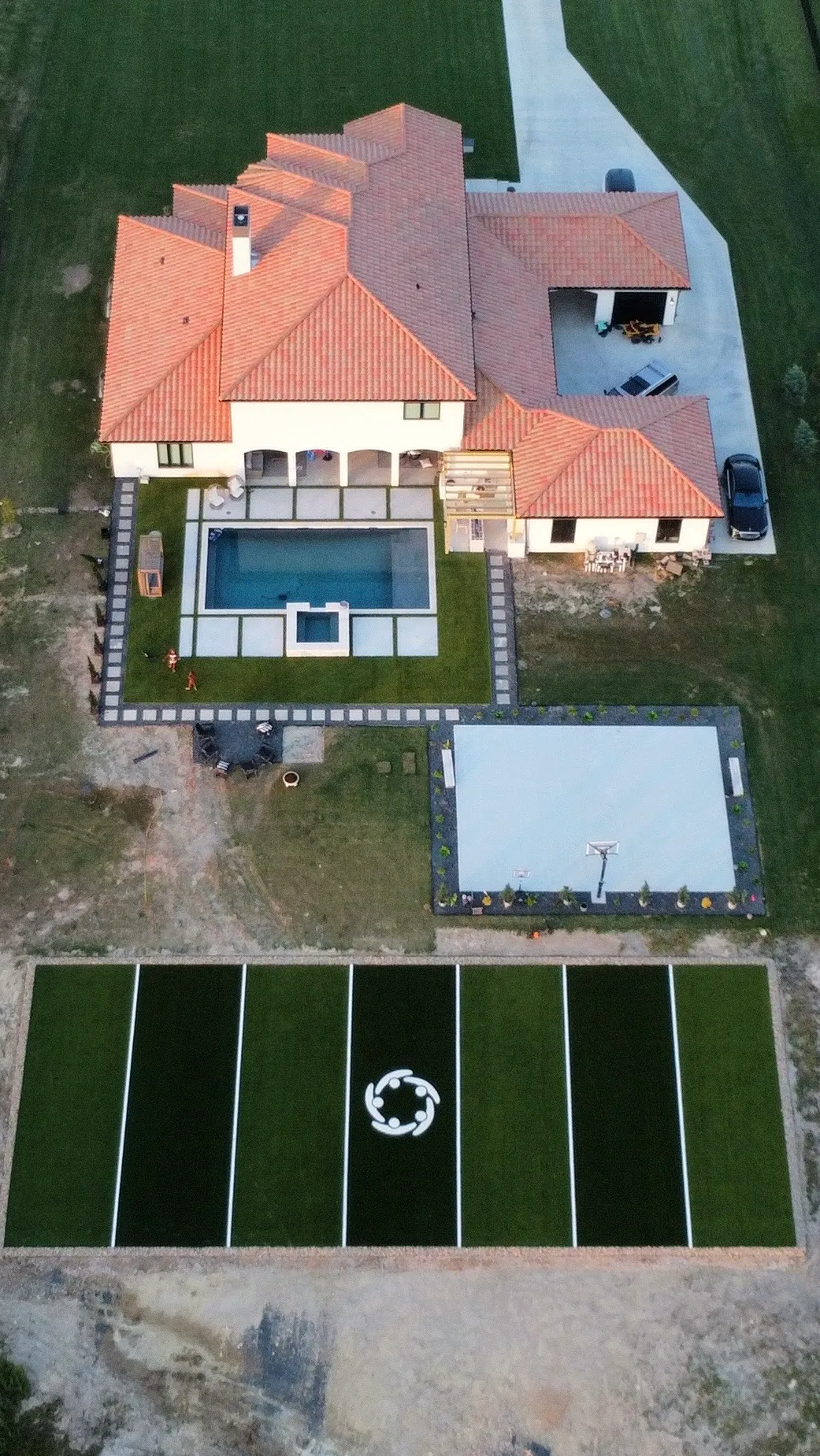
Backyard soccer · DFW
How much does a backyard soccer field cost?
Search that question and Google hands you stadium budgets: $550K and up. Wrong answer for a backyard. A real backyard pitch in DFW runs $6,500 to $40,000 installed depending on size, and this page breaks it down tier by tier.
BBB Accredited · Bonded · Insured · Family-owned, Aledo, TX
Backyard soccer field cost by size.
A backyard pitch prices like any Bearcat residential install: by square footage, base condition, and product tier, using the same rates we publish on our DFW pricing page. The per-square-foot rate drops as the field gets bigger. Here is what the common sizes cost installed in 2026:
| Field size | Area | Installed range | What it plays like |
|---|---|---|---|
| 20 x 40 ft | 800 sqft | $6.5K–$8.5K | Tight side yard or small backyard. First-touch work, passing drills, 1v1, a single small goal. |
| 30 x 50 ft | 1,500 sqft | $10K–$14K | The DFW sweet spot. Small-sided 2v2 and 3v3, full-speed shooting drills, two pop-up goals. |
| 40 x 80 ft | 3,200 sqft | $19K–$26K | Large suburban lot. Real 3v3 and 4v4 games, agility circuits alongside the pitch. |
| 50 x 100 ft | 5,000 sqft | $30K–$40K | Acreage lots (Parker County territory). Small-sided 5v5, permanent goals, room for a keeper to work. |
Base install: excavation, compacted stone base, mid-tier turf, infill, edging, cleanup. Add-ons priced separately: inlaid lines, goals and rebounders, containment netting, lighting, and sport-grade turf in high-wear zones. Complex access or drainage correction moves the number; the free site walk settles it.
What size soccer field fits in a backyard?
Set expectations with the real numbers: a regulation 11v11 pitch is about 360x225 feet, and even a youth 7v7 field is 150x120 feet. Neither fits a residential lot, and any installer who implies otherwise has not measured one. What fits, and what actually gets used every day, is a training pitch:
- 20x40 feet handles first touch, wall passes, and finishing on a single goal. This is also roughly a half-court futsal footprint.
- 30x50 feet is where small-sided games become real: 2v2 and 3v3 with two goals, plus full-speed shooting from distance.
- 40x80 to 50x100 feet (large and acreage lots) supports 4v4 and 5v5 with a working keeper. At this scale families often add agility lanes, a rebounder wall, or a putting green along one edge.
And yes, demand is real right now: with World Cup matches being played up the road in Arlington this summer, every kid in the metroplex wants a pitch. A backyard field is how that enthusiasm survives past July.
If your project is actually field-scale (a club training ground, church rec field, or school pitch), that is institutional work with different engineering: start at our soccer and football field construction page. Between backyard and institutional sits the mini-pitch, the HOA and academy tier.
Built like a field, not a lawn.
The difference between a backyard soccer field and a pretty backyard is what happens in the goal mouth in month six. Wear concentrates in specific zones (goal mouths, shooting lanes, the center of every drill), so that is where the build gets its attention:
- +Excavation, compacted crushed stone base, and laser-graded slope, with extra compaction in goal mouths and drill lanes
- +Sport-grade turf in high-wear zones (the same system we run in batting cage hitting zones); landscape-grade across low-traffic areas where it saves money
- +Line markings your call: painted (changeable) or inlaid contrasting turf (permanent)
- +Goal anchoring, rebounder placement, and containment netting planned into the layout, not bolted on later
- +Drainage engineered for North Texas clay (see how we handle clay soil)
- +15-year manufacturer turf warranty, 1-year Bearcat install warranty, one crew start to finish
Calculate the cost
What would artificial turf cost for your backyard field?
Three quick questions. Real price range for your project in under a minute. No email required to see the number.
Run the Calculator →Sports Attack authorized dealer
Soccer machines for the backyard pitch.
Bearcat is an authorized Sports Attack dealer. Buy the machine with your build or on its own, at the manufacturer’s list price plus published freight.
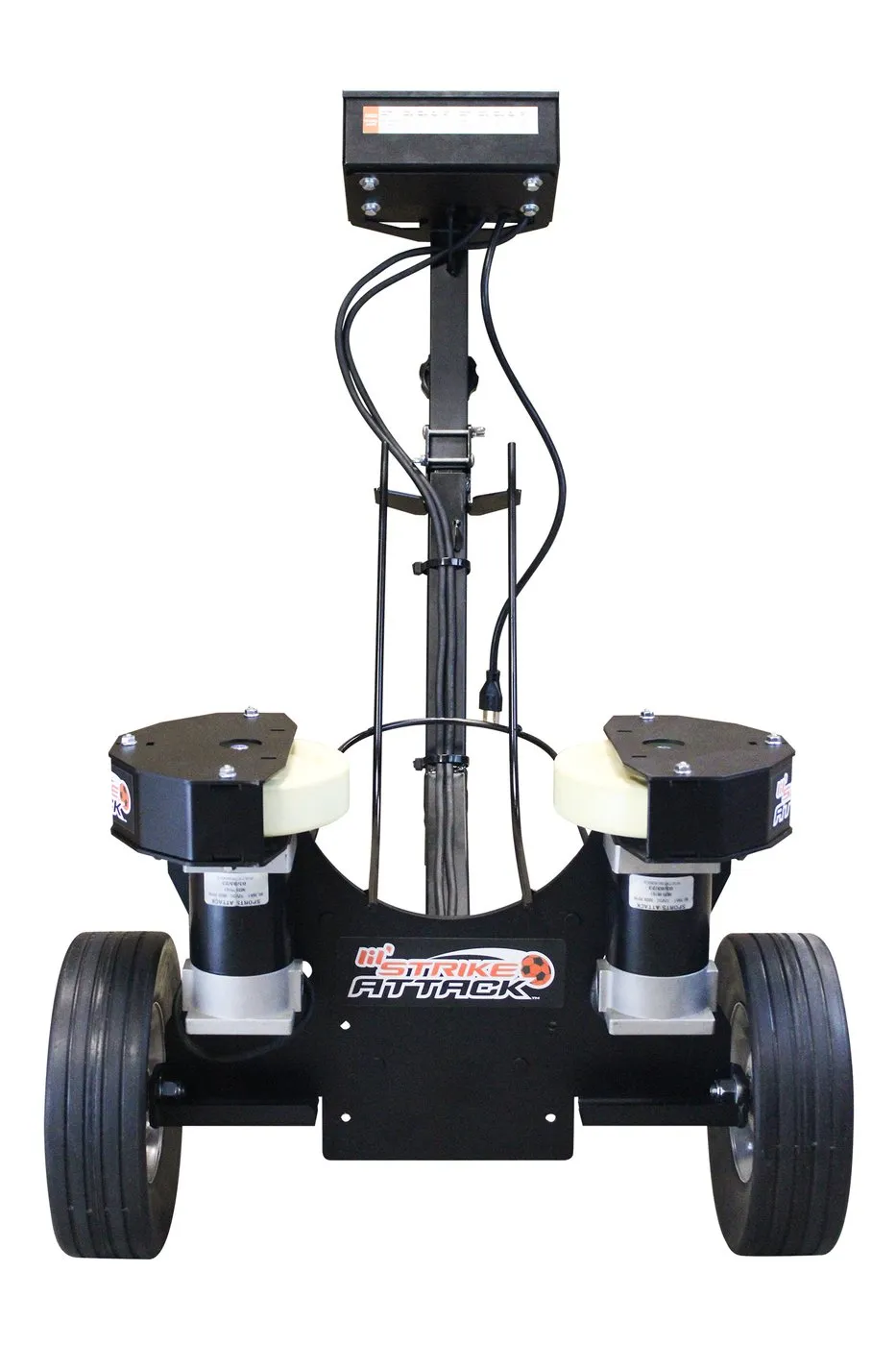
40 MPH, 50 yards
Lil’ Strike Attack
Youth soccer machine for backyards and club training.
From $1,599 MSRP + $160 freight
See specs & pricing →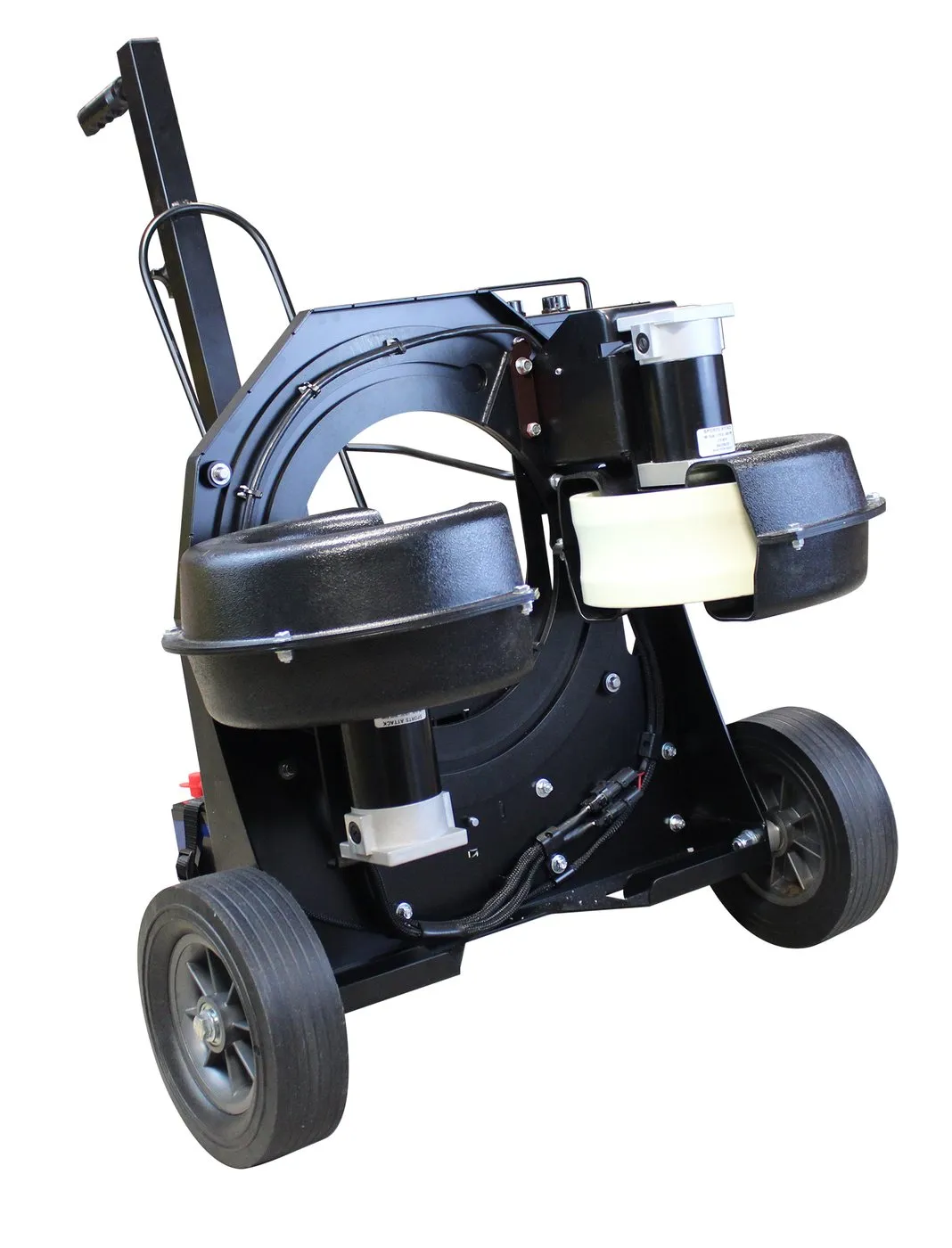
70+ MPH, 70+ yards
Strike Attack
International-speed kicks for keepers, defenders, and attackers.
From $3,099 MSRP + $400 freight
See specs & pricing →Price is MSRP. Machines ship direct from Sports Attack to your door; freight is listed with each machine from the Sports Attack 2026 rate sheet (continental US). Items without a listed rate are quoted. Warranty through Sports Attack. See every Sports Attack machine.
Backyard soccer field questions, answered.
How much does a backyard soccer field cost in DFW? +
Priced like a residential turf install: roughly $7.00 to $9.40 per square foot installed depending on total size, on the same published tiers as any Bearcat backyard project. That puts a 20x40-foot pitch around $6,500 to $8,500, a 30x50 around $10,000 to $14,000, and a 50x100 around $30,000 to $40,000. Inlaid line markings, goals, rebounders, netting, and sport-grade turf in high-wear zones add to the base number. Project minimum is $3,000.
How big should a backyard soccer field be? +
As big as the lot allows after setbacks, trees, and whatever else shares the yard. Common backyard pitches run 20x40 feet up to 50x100 feet, with 30x50 the sweet spot on a typical DFW suburban lot. For reference, even a youth 7v7 pitch is 150x120 feet, which does not fit on a standard residential lot, so backyard fields are training and small-sided spaces, not regulation pitches. We will tell you honestly what your yard supports at the site walk.
Can you play in cleats on backyard turf? +
Molded rubber and turf-specific cleats, yes. In goal mouths, shooting lanes, and other plant-and-cut zones we spec a heavier sport-grade product (the same fiber system we install in batting cage hitting zones) rather than standard landscape turf. Metal studs are hard on any synthetic turf and we do not recommend them on a residential install.
How hot does the field get in a Texas summer, and what helps? +
Turf runs hotter than grass, and July afternoons in DFW are the honest worst case: standard turf can reach 150 degrees or more in direct sun. Lighter fiber colors, heat-reducing infill choices, shade, and a quick hose-down (which drops surface temperature 30 to 50 degrees for a session) all help. Most families simply schedule around it the way they already do for playground equipment and pool decks. Our turf heat guide covers the real measurements.
Painted lines or inlaid lines? +
Painted lines cost less, can be added or changed any time, and need periodic refresh. Inlaid lines are contrasting turf cut and seamed in at install: they cost more up front, last the life of the field, and look like a real pitch. Most families start with paint and a smaller inlaid touch (a center circle or penalty spot); serious training setups go straight to inlays.
What is under the field? Will it drain in a DFW storm? +
The same engineering as every Bearcat install: excavation, compacted crushed stone base, weed barrier, and a laser-graded slope so water sheds instead of pooling at midfield. Goal mouths and drill lanes get extra base compaction because that is where wear and standing water concentrate. On North Texas clay this base work matters more than the turf brand, which is why we publish our drainage spec.
Does a backyard soccer field add home value? +
It shows extremely well in listings for family-buyer neighborhoods, and quality turf is a durable improvement with a 15-year manufacturer warranty. But build it because your kids will use it every day for a decade, not as a resale calculation: like pools, buyer response is personal.
Ready to turn the backyard into a pitch?
We will walk the lot, mark out what actually fits, talk goals and lines, and send a fixed-price proposal. Free, and no pressure in the middle of it.
Related reading
Service page
Backyard sports fields, all sports
The multi-sport version: football, agility, batting, and combination layouts.
The Texas question
How hot does turf get here?
Real surface temperatures, what makes them worse, and what actually helps.
Bigger picture
Turf field cost, every size
From backyard pitches to full stadium fields: the complete 2026 cost spectrum.