Backyard wiffle ball · DFW
Build a backyard wiffle ball field.
Every dad who has watched a kid round an imaginary second base has had the thought: what if the yard was actually a ballpark? It can be. A turf wiffle ball field in DFW runs $7,500 to $43,000 installed depending on size, and this page covers the dimensions, the stadium features, and the honest numbers.
BBB Accredited · Bonded · Insured · Family-owned, Aledo, TX
Wiffle ball field dimensions: there is no rulebook, and that is the point.
Quick answer: a standard backyard wiffle ball field is about 60 to 90 feet down each foul line, with the pitcher 40 to 48 feet from home plate and a home run fence 80 to 100 feet out. Kids’ fields scale down to roughly 30x30 feet, and a strike-zone board of 30x40 inches sits about 3 feet behind the plate.
| Measurement | Typical backyard range |
|---|---|
| Overall footprint | 30x30 ft to 60x90 ft |
| Foul lines | 60 to 90 ft |
| Home run fence (adult) | 80 to 100 ft |
| Pitching distance (adult) | 40 to 48 ft |
| Strike zone board | 30 in wide x 40 in tall, about 3 ft behind home plate |
Unlike soccer or football, wiffle ball has no governing body handing down field sizes. Every legendary backyard park, from the famous ones on the internet to the one you are about to build, is shaped by its yard. That said, decades of backyard stadium culture have settled on a layout that plays right:
- Overall footprint: 30x30 feet on the tight end (a wedge of fair territory and a short porch) up to 60x90 feet for a full showpiece field.
- Foul lines: 60 to 90 feet from home plate to the outfield fence, depending on what the lot gives you.
- Home run fence: 80 to 100 feet for adult play. Shorter for kids, and honestly, shorter fences make for better games: more home runs, more arguments, more legend.
- Pitching distance: commonly 40 to 48 feet for adults. Close enough that a good riser is terrifying, far enough that hitters have a chance.
- Strike zone: a board about 30 inches wide by 40 inches tall, set roughly 3 feet behind home plate. It is your catcher and your umpire in one piece of equipment, and it has never once blown a call it will admit to.
Wondering what fits your yard? Bring a tape measure to the free site walk, or browse the project gallery to see what other DFW backyards turned into.
Backyard wiffle ball field cost by size.
A wiffle field prices like any Bearcat residential install, on published rates: $9.39 per square foot under 500 square feet, $9.17 at 500 to 1,500, $7.85 at 1,500 to 3,000, and $7.00 at 3,000-plus, all installed. Bigger field, better rate. Here is what the common builds cost in DFW:
| Field size | Area | Installed range | What it plays like |
|---|---|---|---|
| 30 x 30 ft | 900 sqft | $7.5K–$9.5K | The tight-yard starter stadium. Short porches, big swings, home runs into the neighbor’s conversation. Kids own this size. |
| 40 x 60 ft | 2,400 sqft | $16K–$21K | The DFW sweet spot. Real pitching distance, a legit outfield gap, room for a fence line that means something. |
| 60 x 90 ft | 5,400 sqft | $32K–$43K | The acreage-lot showpiece. Full 80-plus-foot foul lines, warning track, wall, lights. The yard the whole cul-de-sac plays in. |
Base install: excavation, compacted stone base, mid-tier turf, infill, edging, cleanup. Stadium features (inlaid lines, dirt-look plate area, fencing, walls, lighting) priced separately. For how these numbers compare across every field type and scale, see our complete turf field cost guide.
Stadium features: what turns a lawn into a ballpark.
The turf is the field. These are the details that make it a stadium, and they are where wiffle projects get genuinely fun to build:
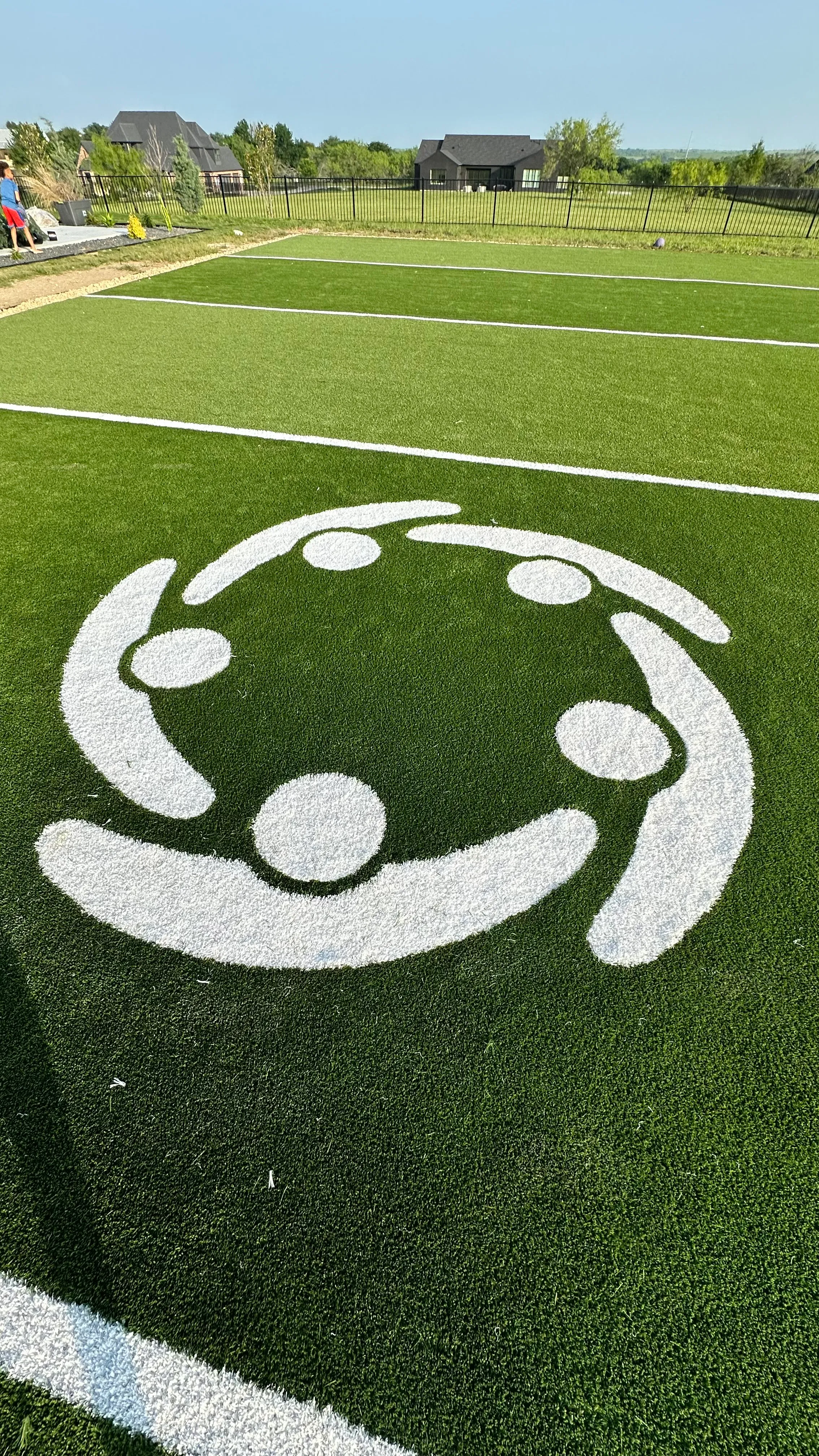
- +Inlaid foul lines and batter’s box: white turf cut and seamed in at install. Permanent, crisp, and no Saturday morning repainting before first pitch.
- +Dirt-look plate area and pitching rubber: contrasting clay-colored turf around home plate and the mound, so the field reads like a real diamond from the back porch. Same technique we cover in our batter’s box and mound guide.
- +Warning track: a contrasting-color strip along the fence line. Purely cosmetic on a wiffle field, and completely worth it.
- +The outfield wall: sports netting for a clean look and contained home run balls, or a mini green-monster plywood wall for full backyard-stadium energy (wall construction by others or coordinated through us).
- +Flood lighting: because the best games in a Texas summer start at 8:30pm. Lighting may need HOA or city sign-off; we flag it at the site walk.
- +Scoreboard mounting: a spot on the wall or fence for the flip-number scoreboard that settles every dispute except the ones worth having.
The honest DIY paragraph.
Plenty of people build wiffle fields themselves, and we respect every one of them. But go in with real numbers: a widely-shared DIY build on a 36x36 field published about $4,600 in materials alone, before a single hour of labor, tool rental, or the three weekends it swallowed. And materials are not where DIY fields fail. Base prep is. On North Texas clay, an uncompacted base swells and dips within a year, and the field that looked perfect in October has a lake behind second base by spring. Our base prep guide explains why what is under the turf matters more than the turf. If you DIY anything, DIY the wall and the scoreboard: those are the fun parts anyway.
One field, every season.
The quiet secret of a wiffle field is that it is a great multi-sport rectangle wearing a baseball costume. Drop pop-up goals on the outfield and it plays like our backyard soccer fields. Run routes across it in the fall like a backyard football field. And the plate area doubles for tee work and soft toss year-round; families serious about baseball training often pair the field with a backyard batting cage down one side of the yard. The field earns its square footage twelve months a year, which is more than the trampoline ever managed.
Backyard wiffle ball field questions, answered.
How much does a backyard wiffle ball field cost? +
Priced like any Bearcat residential turf install, on our published DFW rates: $9.39 per square foot under 500 square feet, $9.17 at 500 to 1,500, $7.85 at 1,500 to 3,000, and $7.00 at 3,000-plus, all installed. That puts a 30x30-foot field (900 sqft) around $7,500 to $9,500, a 40x60 (2,400 sqft) around $16,000 to $21,000, and a 60x90 showpiece (5,400 sqft) around $32,000 to $43,000. Those numbers include excavation, compacted stone base, mid-tier turf, infill, and edging. Stadium features (inlaid lines, dirt-look plate area, fencing, lighting) price separately. Project minimum is $3,000.
What are wiffle ball field dimensions? +
There is no single official size, which is half the fun. Common backyard fields run 30x30 feet on the tight end up to 60x90 feet for a showpiece build. A typical layout runs foul lines 60 to 90 feet to the outfield fence, with the home run fence at 80 to 100 feet for adult play and shorter for kids. Pitching distance is commonly 40 to 48 feet for adults. The strike zone is a board roughly 30 inches wide by 40 inches tall, set about 3 feet behind home plate: it plays catcher and umpire at the same time and never argues a call.
Can the field double for other sports? +
Yes, and most of ours do. The open rectangle takes pop-up soccer goals between games, and the home plate area doubles beautifully for tee work and soft toss. If baseball training is the bigger priority, look at our backyard batting cage and backyard football field guides: a lot of families combine a wiffle layout with a cage down one side.
Do I need a permit or HOA approval in DFW? +
The turf itself generally needs no permit: it is a landscape surface, same as a lawn. Fences and lighting are where cities and HOAs get interested, so a home run wall or flood lights may need HOA or municipal sign-off depending on height and placement. We flag exactly what needs approval at the site walk so nothing stalls mid-build.
How hot does the field get in a Texas summer? +
Honest answer: hotter than grass. Standard turf in direct July sun can hit 150 degrees or more. A quick hose-down drops the surface 30 to 50 degrees for a game, lighter fiber colors and heat-reducing infill help, and most families schedule around the worst hours the same way they do for the pool deck. Evening games under lights are the North Texas move anyway. Our turf heat guide has the real measurements.
How long does a turf wiffle ball field last? +
The turf carries a 15-year manufacturer warranty, backed by Bearcat’s 1-year installation warranty, and wiffle ball is about the gentlest sport a turf field will ever host: no cleats, no sliding leagues, a ball that weighs two thirds of an ounce. Built on a properly compacted base, this field outlasts the kids’ entire childhood and keeps going for the grandkids’ era.
Heat details live in our Texas turf heat guide, with real surface temperature measurements.
If you build it, they will come. (They live upstairs.)
We will walk the yard, chalk out the foul lines, talk fence distance and strike zone placement, and send a fixed-price proposal. One crew handles it start to finish, and the whole thing is more fun than most site walks, we admit it.
HUB Certified woman-owned · BBB Accredited · 15-year turf warranty
Related reading
Baseball families
Backyard batting cages
The training half of the equation: cage sizes, netting, and turf hitting zones for DFW backyards.
Fall season
Backyard football field guide
Same rectangle, different lines: costs, dimensions, and layouts for a backyard gridiron.
Build quality
Base prep matters more than the turf
Why fields fail from underneath, and what a properly compacted base looks like on North Texas clay.