Indoor facility budgeting
How much does it cost to build an indoor baseball facility?
Real planning ranges for turning an existing building into a baseball or softball training facility, priced per tunnel and per square foot, with the building cost separated from the fit-out so you can see which number is yours and which is ours.
Updated · 2026 pricing from Bearcat Turf & Outdoors, built in Texas, Oklahoma, Louisiana, Arkansas, Kansas, New Mexico, Nebraska & Georgia
The short answer.
For the fit-out of an existing building, plan on $23K to $35K per tunnel, or about $20 to $30 per square foot of clear floor, before pitching machines, lighting, permits, and the building itself. Sized by tunnel count, that is three packages:
Starter · 3 to 4 tunnels
$90K to $140K
About 3,500 to 5,000 sq ft of clear floor
- Per tunnel
- about $33K
- Per sq ft
- about $27
A coach or small club opening a first facility, or a high school program adding a winter hitting room.
Training Center · 5 to 8 tunnels
$160K to $245K
About 6,000 to 10,000 sq ft of clear floor
- Per tunnel
- about $31K
- Per sq ft
- about $25
A full-time training business with team rentals, lessons, and a viewing area.
Academy · 9 to 12+ tunnels
$230K to $420K+
About 10,000 to 20,000+ sq ft of clear floor
- Per tunnel
- about $31K
- Per sq ft
- about $22
A multi-sport academy or travel organization with a full indoor infield, bullpens, and a team room.
Per-tunnel and per-square-foot figures are the midpoint of each range divided by the midpoint tunnel count and floor area. They are planning yardsticks. Ranges move with building condition, slab, ceiling height, and finish level. We confirm a fixed price after a site visit or a video walkthrough.
Two budgets, not one
Every number above is the fit-out. The building is a second budget, and it is usually the larger one over time.
The fit-out is what Bearcat builds and prices: turf, netting, frames, dividers, floor, fencing, electrical, sound, security, and install. The shell is the building you lease or buy plus what it needs to pass inspection. The two sections below split them apart, then put them back together for a Training Center on an 8,000 sq ft floor.
See the shell vs fit-out split ↓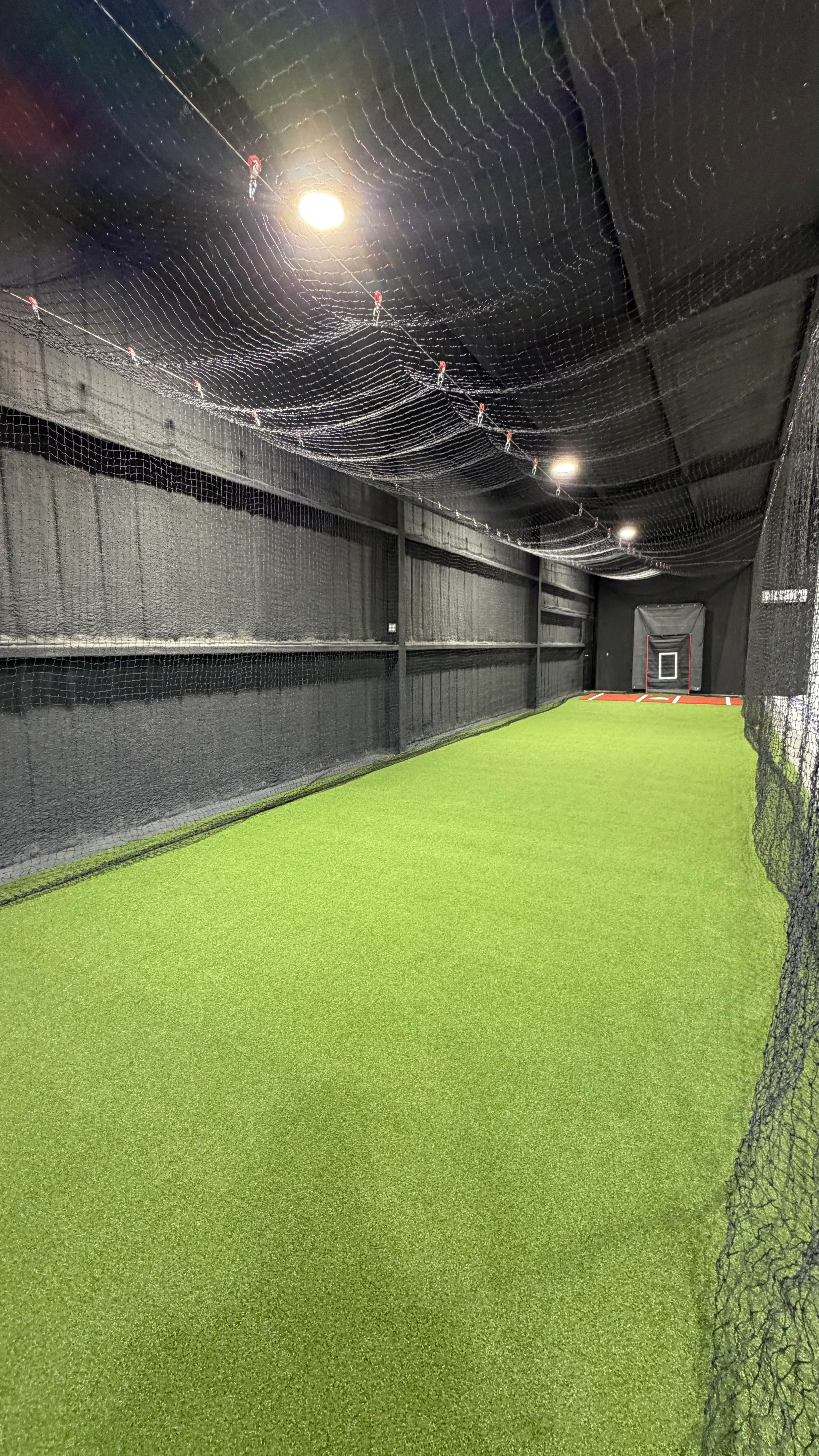
Cost per tunnel and per square foot, by package.
Tunnel count is what the business runs on, and floor area is what the lease runs on. Both yardsticks are below so you can check a building against a budget before you call anyone.
| Package | Tunnels | Clear floor | Fit-out range | Per tunnel | Per sq ft |
|---|---|---|---|---|---|
| Starter | 3 to 4 tunnels | 3,500 to 5,000 sq ft | $90K to $140K | about $33K | about $27 |
| Training CenterMost common | 5 to 8 tunnels | 6,000 to 10,000 sq ft | $160K to $245K | about $31K | about $25 |
| Academy | 9 to 12+ tunnels | 10,000 to 20,000+ sq ft | $230K to $420K+ | about $31K | about $22 |
Fit-out only. Excludes pitching machines, lighting, HVAC, permits, and the building. Smaller buildings run toward the high end per square foot because electrical, the lobby, sound, and security do not shrink with the floor.
What each package includes
Starter
- Cable-hung or framed netting per tunnel
- Hitting turf with pad
- Sliding or fixed dividers
- Floor prep and basic electrical
Training Center
- Full-shell netting at 16 ft
- Sliding dividers between tunnels
- Turf with whiffle or fielding inlay
- Epoxy floor, fencing, bar top, electrical, sound, security
Academy
- Everything in Training Center
- Open turf infield or fielding zone with perimeter netting
- Bullpen and mound work
- Lighting and HVAC coordination
What the shell costs vs what the fit-out costs.
Owners get surprised when a $200K fit-out quote turns into a $350K opening budget. The gap is the shell: the building and everything it needs that is not turf or netting. Here is who carries what.
The shell · your budget
The building, and what it needs to be legal and comfortable.
- The building. Lease or purchase. The biggest number in the project and the one we do not control.
- Slab repairs or topping pour. Most existing slabs work. Some need grinding or a topping pour before anchors go in.
- HVAC. Return placement that does not pull dust off the turf. Often the largest shell upgrade in an older metal building.
- Lighting. LED high bays over every tunnel. Quoted separately because fixture count follows the building, not the package.
- Permits and zoning. Change-of-use, occupancy, and fire marshal review vary by city.
- Restrooms, office, parking. Code-driven. An older warehouse may need a second restroom or an accessible route.
The fit-out · our scope
Everything that turns the room into a facility. This is what the packages price.
- Hitting turf with pad. Padded, infill-free turf across every tunnel and any inlay or fielding area.
- Netting and rigging. Full-shell netting at 16 ft, cable or frame hung, with fixed or sliding dividers.
- Cage frames and hardware. Frames, cable, hardware, L-screens, and machine pads.
- Epoxy floor, fencing, bar top. The build-out trades that make it a business instead of a room with nets.
- Electrical, sound, security. Machine circuits, speakers, cameras, and door access, coordinated with the net rig.
- Install, welding, project management. One crew, one schedule. The same people who hang the net set the machine pad.
A real fit-out, split in two
Seven tunnels in an existing North Texas building: ~$206K, or ~$29K per tunnel.
16 ft full-shell netting, six sliding dividers, ~9,300 sq ft of padded hitting turf with a whiffle inlay, and a viewing area. The building was a separate lease and is not in these figures. Client name withheld at the owner's request. Figures are rounded.
Turf and netting package
~$120K (58%)
Hitting turf, cage frames, netting and dividers, install materials, and the install crew.
Build-out trades
~$86K (42%)
Fencing, epoxy floor, electrical, bar top, and allowances for sound and security.
Not in any range on this page
- Pitching machines (Bearcat is an authorized Sports Attack dealer, so they can ride on the same proposal)
- Hit tracking systems such as HitTrax
- Lighting and HVAC work
- Permits and change-of-use approvals
- The building itself, lease or purchase, and any deposits or build-to-suit costs
- Working capital for the first months of operation
The building
Lease or buy the building?
The fit-out is the same either way. What changes is how much cash you need on opening day and who owns the improvements when you leave. Most first facilities lease. Here is the trade.
Lease
Fit-out plus deposits to open
- · Opening budget is the fit-out, first and last month, and a security deposit
- · Prove the business before committing to real estate
- · Landlord may fund HVAC, lighting, or slab work as a tenant improvement allowance in exchange for term
- · Netting anchors, epoxy, and electrical need written landlord consent before you sign
- · You leave the improvements behind at the end of the term, so negotiate length and renewals up front
Buy
Fit-out plus a down payment
- · Down payment on a commercial loan, typically a meaningful share of the purchase price
- · Every improvement adds to an asset you own
- · Makes sense when you will hold the building a decade, or when the market has few leasable buildings with 16 ft clear
- · A partner or investor can hold the real estate while the operating company leases from them
- · You carry roof, slab, and HVAC replacement with no landlord to call
| Training Center, 8,000 sq ft floor | Lease | Buy |
|---|---|---|
| Fit-out (the package) | $160K to $245K | $160K to $245K |
| The buildingmarket context, not a Bearcat figure | $4,000 to $8,000 a monthat $6 to $12 per sq ft per year, NNN | $400,000 to $880,000at $50 to $110 per sq ft for an existing building |
| Cash to open, before machines and lighting | Fit-out plus two to three months of rent as deposits | Fit-out plus the down payment and closing costs |
| Who owns the improvements | The landlord, at the end of the term | You |
Lease and purchase figures are general market context for older flex and metal-building space in the states we build in, shown so the arithmetic is visible. Your broker will have current numbers for your city. Clear height, column spacing, and slab condition matter more than the rate.
Run the numbers for your facility
Indoor facility ROI calculator
Enter your build cost, rent or mortgage, hourly rate, open hours, and staff. See monthly net, payback, and the break-even utilization you need. No email gate.
Open the ROI Calculator →Have a building, or one under contract?
Send the dimensions and we will draw the tunnel layout and price it.
Building size, clear height, and the tunnels you want. That is all we need to recommend a package and send a working budget within one business day.
Decisions that move the budget.
If you have to cut, here is what to cut and what not to cut.
- Do not cut ceiling height. 14 ft clear is the minimum for machine work and 16 ft is what a full-shell net wants. A cheaper building with 12 ft clear is not cheaper. It is a different business.
- Full shell or lane-only netting. A 16 ft full shell encloses the whole tunnel. Lane-only nets cost less and protect less of the room. Match it to your ceiling and your hitters.
- Sliding or fixed dividers. Sliding dividers let one coach run a team across three lanes, then close them for lessons. They cost more and they are how the floor earns during team hours.
- Epoxy or bare concrete. Epoxy was the largest build-out line on the real 7-tunnel build. Bare concrete saves it, at the cost of dust in the HVAC and a rougher finish for parents in the lobby.
- Phase the tunnels, not the rig. A Starter facility can grow into a Training Center without re-rigging the first tunnels if the netting cable and electrical are laid out for the full count on day one.
- Machines on the same proposal. Pads, power, and L-screens are poured and wired during the build. Bearcat is a Sports Attack dealer, so machines ship with the tunnels instead of being bolted on after.
- Check the building before the budget. Columns inside a lane, a slab that needs a topping pour, or a power service that cannot carry machine circuits each add more than any package upgrade. Run the building checklist first.
Where we build · 8 states
Building in Texas, Oklahoma, Louisiana, Arkansas, Kansas, New Mexico, Nebraska & Georgia.
The fit-out ranges on this page hold across the states we build in. What changes by state is the building stock, the permit path, and how far the crew travels. Pick your state for how an indoor facility build works there.
Home base
Texas
Indoor baseball facility builds in Texas →
OK
Oklahoma
Indoor baseball facility builds in Oklahoma →
LA
Louisiana
Indoor baseball facility builds in Louisiana →
AR
Arkansas
Indoor baseball facility builds in Arkansas →
KS
Kansas
Indoor baseball facility builds in Kansas →
NM
New Mexico
Indoor baseball facility builds in New Mexico →
NE
Nebraska
Indoor baseball facility builds in Nebraska →
GA
Georgia
Indoor baseball facility builds in Georgia →
Outside DFW we start with a virtual consult over video, so nobody drives out before the budget makes sense. All markets and what travels to each →
Indoor baseball facility cost FAQ.
How much does it cost to build an indoor baseball facility?
For the fit-out of an existing building, plan on roughly $23K to $35K per tunnel, or about $20 to $30 per square foot of clear floor, before pitching machines, lighting, permits, and the building itself. That puts a 3 to 4 tunnel Starter facility at $90K to $140K, a 5 to 8 tunnel Training Center at $160K to $245K, and a 9 to 12 tunnel Academy at $230K to $420K or more. A recent 7-tunnel build in North Texas came in around $206K, or about $29K per tunnel.
How much does an indoor baseball facility cost per tunnel?
About $23K to $35K per tunnel for a build with padded turf, full-shell netting, dividers, epoxy floor, fencing, electrical, and finishes. The low end is a cable-hung tunnel in a building with a good slab and existing power. The high end adds sliding dividers, a 16 ft full shell, an inlay, and a lobby. Machines and lighting are extra.
How much does an indoor baseball facility cost per square foot?
Roughly $20 to $30 per square foot of clear floor for the fit-out, at typical tunnel layouts. Smaller buildings run toward the high end because fixed items like electrical, the lobby, sound, and security do not shrink with the floor. That figure does not include the building, HVAC, lighting, or permits.
What does the shell cost compared to the fit-out?
The fit-out (turf, netting, frames, dividers, epoxy, fencing, electrical, sound, security, and install) is the part we price, and it is the ranges on this page. The shell is the building itself plus anything the building needs to be legal and comfortable: slab work, HVAC, lighting, permits, restrooms, and parking. On the real 7-tunnel build, the turf and netting package was about 58% of the fit-out and the build-out trades were the other 42%. The building was a separate lease.
Should I lease or buy the building for a baseball training facility?
Most first facilities lease, because it keeps the opening budget to the fit-out plus deposits and lets you prove the business before committing to real estate. Buying makes sense when you can hold the building for a decade, when the market has few leasable buildings with 16 ft clear height, or when a partner wants the real estate as the investment. Either way, get the landlord or seller to agree in writing to the netting anchors, the epoxy floor, and any HVAC or electrical upgrades before you sign.
How big a building do I need?
Plan 12 to 15 ft of width and 80 ft or more of length per tunnel, with 14 ft of clear ceiling as the minimum and 16 ft preferred. A 60 ft by 100 ft building fits four tunnels with a walkway. A 5 to 8 tunnel Training Center wants 6,000 to 10,000 sq ft of clear floor. Columns inside a lane are a deal breaker, so send us the column grid before you sign.
What is not included in these ranges?
Pitching machines, hit tracking systems, lighting, HVAC, permits, the building itself, and working capital. We can put machines on the same proposal as the tunnels, and we coordinate lighting and HVAC with your electrician and mechanical contractor so the fixtures and returns land where the nets allow.
How long does the build take?
A 5 to 8 tunnel facility in an existing building is typically a matter of weeks on site once materials are in, not months. Floor work, electrical, and permits set the schedule, and we map them during the site visit or video walkthrough.
Is a softball training facility priced the same way?
Yes. The tunnel is the same. What changes is the pitching distance, the mound or flat-ground setup, and the machine selection. Many facilities run both, and we lay out the floor so a tunnel converts between them.
Do you build indoor baseball facilities outside Texas?
Yes. For full indoor facility builds we travel across Texas, Oklahoma, Louisiana, Arkansas, Kansas, New Mexico, Nebraska & Georgia. Outside DFW we start with a virtual consult over video, so nobody drives out before the budget makes sense. See the state pages for how a build works in each one.
Ready to put a real number on it?
Send the building plan or the dimensions. We will draw the tunnel layout, recommend a package, and put together one fixed-price scope for the fit-out. Free site visit in DFW, a virtual consult everywhere else, and a response within one business day.
1
You send the building
Dimensions, clear height, column grid, and whether you own it, lease it, or are still looking.
2
We draw the layout
How many tunnels fit, where the lobby goes, and what the slab, power, and HVAC need before anchors go in.
3
You get a fixed price
Not a range. One scope for the fit-out you can take to a lender, a landlord, or a partner.
Keep exploring
Pillar
Indoor baseball & softball facilities
The full offering: packages, what your building needs, and the design decisions that decide how the facility earns.
Cost guide
What a 7-tunnel build cost
A real contract, line by line, and how it scales to 6, 9, or 12 tunnels.
Calculator
Operator ROI calculator
Payback and break-even from your own rate, hours, and costs.
Owner guide
How to start a batting cage business
The seven steps from market check to lease, with a worked break-even.
Checklist
Is this building a facility?
Enter your dimensions to see how many tunnels fit and what to verify before you sign.
Outdoor
Youth baseball field cost
Outdoor field costs by tier, if the plan is a field instead of a building.
Indoor
Indoor athletic facility construction
Multi-sport, cricket, soccer, and whiffle ball facilities on the same one-scope build.