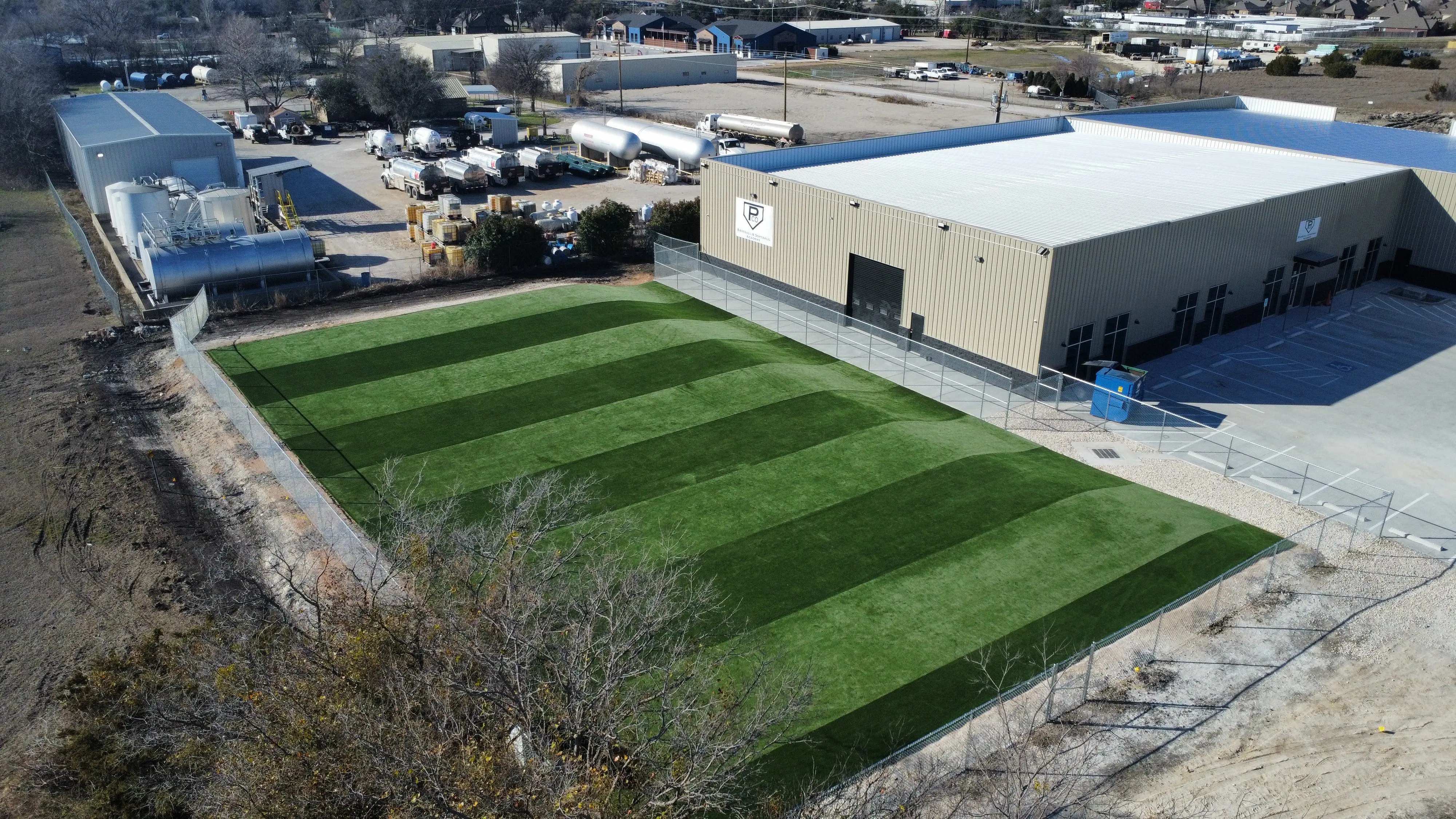
For Architects, Engineers, & Public-Bid Procurement
How we build a premium soccer & football field.
The performance of a sports field is decided by what's underneath it: how water is collected and conveyed, how the base resists movement, and how tight the finish tolerances are held. Here is the drainage engineering, base spec, and G-Max standard we build to on every multi-use field, plus what we send with a bid.
What's under the surface
A Bearcat sport-field section, layer by layer.
Sport fields fail when somebody cuts the base. Here's the exact spec we build to — engineered for ASTM compliance, GMAX impact attenuation, and a 15-year service life.
Tap a layer to read the engineering detail.
Layer 1: Sport-grade turf
Slit-film or monofilament fiber engineered for repeated cleated impact. Seam tested to ASTM F1936 specifications.
Spec: ASTM F1936 (synthetic turf for athletic fields).
Layer 2: Performance infill
Engineered blend of silica sand + crumb rubber (or alternative TPE / cork blends). Application rate validated to GMAX impact attenuation specification for the field type.
Spec: GMAX < 165 (per ASTM F355) at install and after 8 years.
Layer 3: Shock pad (optional)
Closed-cell foam underlay. Required for IPEMA-certified playground installs and recommended for high-impact athletic fields.
Spec: IPEMA / ASTM F1292 critical fall height rating.
Layer 4: Compacted aggregate base
Larger aggregate (1" → 3/8" graded). Two-lift install, compacted to 95% Standard Proctor. Sport-field bases are deeper than residential to handle dynamic loads from cleated traffic.
Spec: 95% Std Proctor across both lifts.
Layer 5: Drainage system
Perforated PVC drain network on a 1–2% laser-graded slope. Geotextile separator above. Where soil conditions require, a sub-base lime or cement-treated stabilization layer.
Spec: Drainage rate > 30 in/hr per ASTM F1551.
Drainage engineering — sized to the storm, not guessed.
Every drainage system on a Bearcat field starts with a hydrology calculation, not a pipe-size default. Using a 1.0 inch-per-hour design storm across a fully contributing field surface, the math works out to approximately 0.0104 gallons per minute of required capacity per square foot, per inch/hour of rainfall intensity. On a 213,000-square-foot multi-use field, that's roughly 2,210 GPM at a 1.0 in/hr storm — scaling to about 1,150 GPM at 0.5 in/hr and 4,600 GPM at 2.0 in/hr, the range North Texas sees in its harder summer storms. We size collector pipe, panel spacing, and outfall connections against that number, not against "it drained fine last time."
- Standard system: 18″ perforated HDPE N-12 collectors plus 12″ lateral feeders, washed #57 drain stone backfill, non-woven geotextile under-liner. Designed to evacuate 3–4 inches of rain per hour and return the field to playable condition within 30 minutes.
- Flat-panel herringbone upgrade: parallel flat-panel underdrains at roughly 18.5 ft on-center in a chevron pattern, cutting the lateral distance water travels through the base before it hits a collection line. We spec this over standard collector pipe on tight-timeline builds, expansive-clay sites, and fields tight against retaining walls where routing a full lateral grid is harder.
- Discharge coordination: subsurface drainage performance assumes the downstream civil outfall structures and site storm piping carry adequate capacity. We confirm points of connection and invert elevations with the project's civil engineer before pricing, not after.
The mechanism behind all of it — why a high carpet permeability rating doesn't guarantee a dry field on North Texas clay — is covered in our turf permeability and drainage reference.
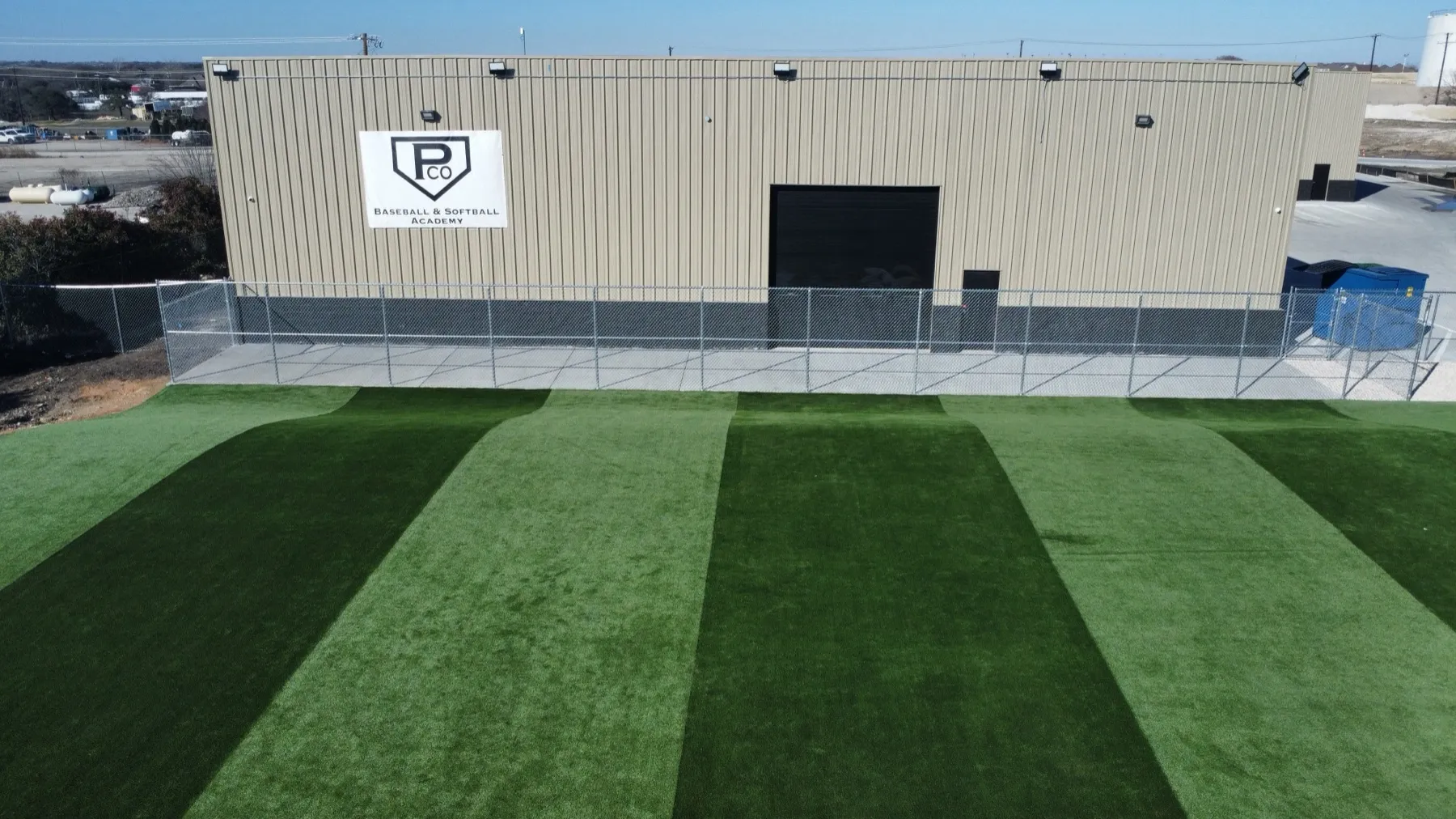
Base & laser grading
- Separation fabric: continuous 8 oz needle-punched nonwoven geotextile over the prepared subgrade, preventing native clay fines from migrating up into the stone base.
- Aggregate base: 6 inches of compacted #57 drain stone across the full footprint, compacted to a minimum of 95% Modified Proctor density.
- Finish tolerance: laser-graded to within ±0.05 ft (about a quarter inch) over the field envelope, with a 0.2%–0.5% designed planar slope carrying water toward the drainage collection edge. Tolerance protects ball roll and footing; slope is what actually moves the water — a spec needs both.
Perimeter curb & turf attachment
Continuously reinforced 12″ × 12″, 4,000 psi concrete curb around the full field perimeter, reinforced with two continuous #4 rebar runs and control joints at 10-foot maximum intervals. A pressure-treated composite nailer is mechanically anchored to the interior face so the turf seams to a solid edge instead of a stone face — the detail that keeps edges from curling and eroding over the life of the field.
Shock pad & G-Max
A closed-cell shock pad between the stone base and the turf carpet is the single biggest lever on player-safety numbers: it drops a new field from the 140–160 G-Max range (no pad) into 90–110, and it's effectively required by insurers for youth competitive play. We hold fields to no greater than 130 G-Max at installation, verified by an independent third-party testing firm, staying well clear of the 165 recommended ceiling and the 200 ASTM F1936 never-exceed limit. The full number tiers, and what to write into a bid spec, are in our G-Max guide for athletic directors and the spec-writer version at /specifications/gmax-testing.
Infill system
A dual-layer system installed in controlled lifts and power-broomed between passes: a silica sand ballast layer (roughly 1.0 lb/SF) to seat the backing and stabilize the fiber, topped with a crumb rubber performance layer (roughly 1.5 lb/SF) for impact absorption and traction. Organic alternatives — coconut, cork, or coated sand — are available where heat or allergen concerns drive the spec.
The six-stage build.
Every field follows the same sequence, whether it's a 200,000-square-foot multi-use surface or a smaller school build. Materials and quantities scale to the project; the order doesn't. For the full line-item version with 2026 pricing, see our 17-step build and cost deep-dive.
- 1Mobilization. Site logistics, staging, safety controls, and survey layout from established civil control points.
- 2Drainage. Collector system (standard or flat-panel) installed with continuous fall to designated outfalls, in alignment with the site's civil grading plan.
- 3Perimeter curb & nailer. Continuous concrete curb poured and anchored nailer installed to restrain the base and turf edges before any stone goes down.
- 4Base & finish grading. Aggregate base placed, compacted, and laser-graded to tolerance with the designed planar fall.
- 5Shock pad & turf. Pad installed continuously, turf rolled, seamed, and lines/logos inlaid for durability — not painted on top.
- 6Infill, testing & turnover. Infill installed and groomed, independent G-Max testing, maintenance training, and delivery of the field groomer to the owner.
Why the engineering matters more than the price per square foot.
Athletic facilities get planned around a 10-year-plus service horizon, and over that horizon the real cost of a field is set by lifecycle stability, not the number on the winning bid. An underbuilt system shows up as water pooling in the sub-base and saturating infill after moderate storms, expansive clay heaving an unseparated or under-drained base into soft spots and trip hazards, and carpet backing sitting submerged during wet cycles until the adhesive and fibers fail years ahead of schedule. An engineered system — multi-tiered drainage sized to the storm, a geotechnically aligned base, and independent shock-pad protection — is what keeps a field playable, safe, and on its original schedule for the full 10 years instead of the first three.
Clarifications & exclusions.
Stated up front in every Bearcat institutional bid, so a comparison against another bidder's number is apples-to-apples:
- Mass earthwork, benchmark control, rough grading, and global retention/detention are provided by others unless itemized separately.
- Subgrade is assumed delivered within design tolerance, free of debris, and compacted to specified density before we start.
- Storm-outfall points of connection are assumed available at the field perimeter, at inverts that support gravity drainage.
- Field lighting, scoreboards, netting, fencing, vertical structures, and offsite utility work are excluded unless itemized as a separate line.
Bid documentation.
On request, we provide the following with our bid submission:
Compliance
Texas HUB certification (Comptroller), TX Secretary of State registration, Vendor ID
Insurance & bonding
Commercial general liability COI, performance and payment bonds available at cost
Engineering
Drainage capacity calculation, base-prep spec, slope plan, stone gradation cut sheet
Materials
Turf product spec sheet, infill MSDS, warranty document, G-Max test documentation
Schedule
Gantt chart across all six build stages, from mobilization to final walkthrough
References
Prior public-sector and club installs with AD / facilities-director contacts on request
Before you publish your ITB.
If you're drafting an RFP or Invitation to Bid for a soccer or football field, we'll review the spec language before you post it. The mistakes we see most often:
- Drainage specified as "adequate" instead of a GPM capacity tied to a stated design storm, which lets every bidder assume a different number.
- No slope requirement alongside the grading tolerance — a flat, in-tolerance base still holds water.
- Single-sourcing a turf brand that restricts competitive bidding without improving the finished field.
- No independent G-Max requirement at closeout, letting the installer certify its own work.
Procurement contact
For RFQs, ITBs, pre-bid spec review, and procurement questions:
Call or text 817-803-1445 · or use the contact form — routes to Colin within one business day.
Specification questions, answered.
How much stormwater drainage capacity does a synthetic turf field need? +
Size it to the field, not a rule of thumb. Using a 1.0 inch-per-hour design storm across a fully contributing surface, a field needs to collect and convey roughly 0.0104 gallons per minute per square foot, per inch/hour of rainfall intensity. On a 213,000-square-foot multi-use field that works out to about 2,210 GPM at a 1.0 in/hr storm, scaling to roughly 1,150 GPM at 0.5 in/hr and 4,600 GPM at 2.0 in/hr. A drainage design that never runs this math is guessing.
What is a herringbone flat-panel drain layout? +
A drainage pattern where flat-panel underdrains (as opposed to round perforated pipe) run in parallel lines across the field at a fixed spacing, typically around 18.5 feet on-center, angled into a chevron or herringbone orientation so no point on the field is far from a collection line. It cuts the lateral distance water has to travel through the base before it reaches a drain, which matters most on tight timelines, expansive clay sites, and builds adjacent to retaining walls where standard collector-and-lateral pipe runs are harder to route. We spec it as an upgrade over our standard perforated HDPE collector system on projects where the site conditions call for it.
What laser-grading tolerance does a sports field base need? +
Bearcat laser-grades the finished aggregate base to within ±0.05 ft (about a quarter inch) across the field envelope, with a 0.2%–0.5% designed planar slope carrying water toward the drainage collection edge rather than letting it sit flat. Tolerance and slope are two different jobs: tolerance keeps ball roll and footing consistent, slope is what actually moves the water. A spec that only calls out one of the two hasn't specified drainage.
What G-Max testing happens at closeout on an institutional turf field? +
Independent, ASTM-accredited third-party G-Max testing at multiple points across the field, always including the high-wear zones (goal mouths, midfield, between the hashes), not just a single midfield reading. The report becomes the baseline every future annual test gets compared against. See our full G-Max breakdown for the number tiers and what to write into a bid spec.
What's included in a synthetic turf sports field bid package? +
Every Bearcat institutional bid is scoped line by line: mobilization, drainage (collector system and any drainage upgrade), perimeter concrete curb and nailer, aggregate base and laser grading, shock pad, turf and inlaid markings, infill, and closeout (G-Max testing, groomer equipment, maintenance training). We also state clarifications and exclusions in writing, so you know exactly what is and is not in scope before you compare it to another bidder's number.
Related resources
Scope & pricing
Soccer + football field construction
2026 cost ranges and what's included, for the first phone call.
For bid writers
Model bid spec
Adaptable bid language that holds every bidder to the same written standard.
Baseball spec
Baseball field specifications
The same engineering discipline, applied to baseball and softball infield builds.